For adults who know their attention does not behave the same way all day. Some tasks will not start however hard you push, and others pull you in on their own. Both are part of the picture, and neither is a verdict on how you are doing.
Two weeks of light noticing gives you and your clinician a record of where ADHD shows up, where it eases, and what was around it at the time. It is not a score, and partial entries still count.
For use alongside therapy, not as a substitute. This worksheet is for noticing your own pattern, not for scoring yourself or measuring how much ADHD affects you. Making sense of what the pattern means is a conversation to have with a clinician.
What is inside
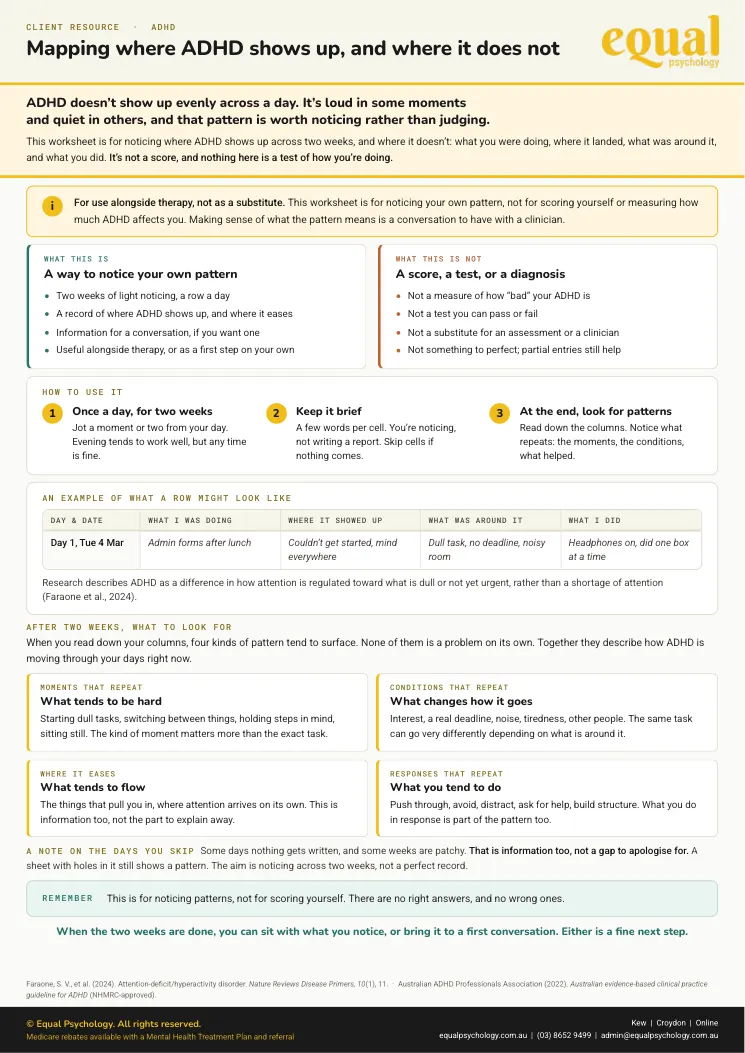
Page 1, read first.What the sheet is and is not, an example row, and four kinds of pattern to look for after two weeks:
Moments that repeat
What tends to be hard
Conditions that repeat
What changes how it goes
Where it eases
What tends to flow
Responses that repeat
What you tend to do
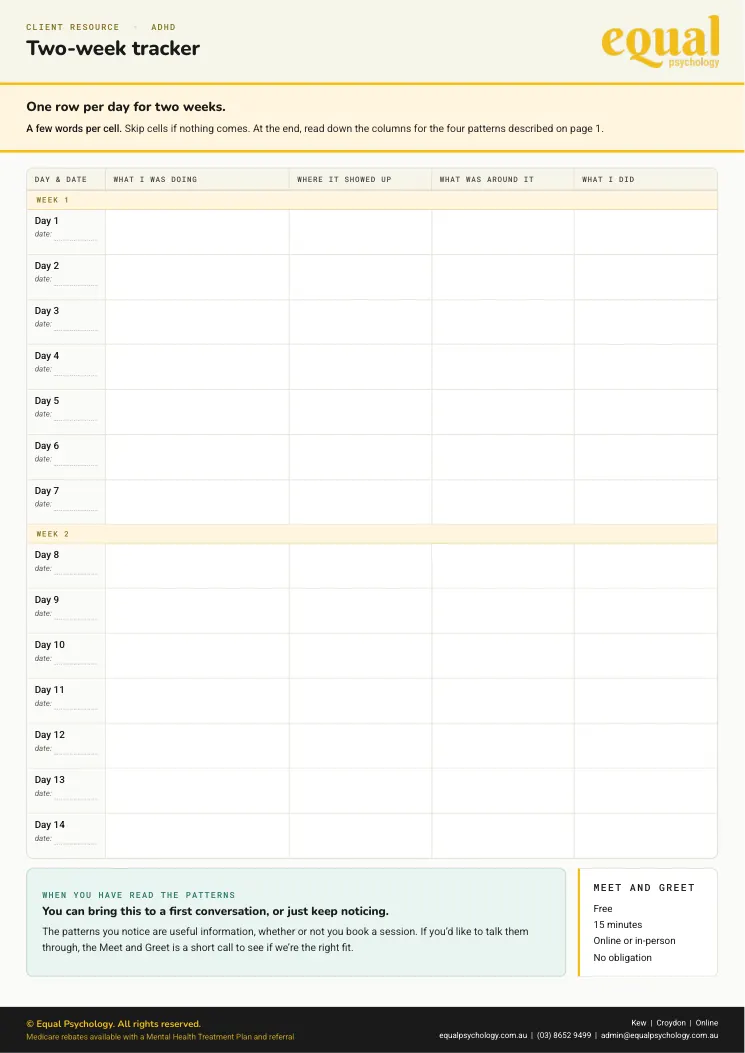
Page 2.A two-week tracker with one row per day: what I was doing, where it showed up, what was around it, and what I did. At the end, you read down the columns for the four patterns.
Page 1 · Read firstPage 2 · To fill in
How to use it
1Once a day, for two weeksJot down a moment or two from your day. Evening tends to work well, but any time is fine.
2Keep it briefA few words per cell. You are noticing, not writing a report. Skip cells if nothing comes.
3Read down the columnsAt the end of the two weeks, look for what repeats: the moments, the conditions, what helped. Bring it to a session if you would like to talk it through.
Some days nothing gets written, and some weeks are patchy. That is information too, not a gap to apologise for. A sheet with holes in it still shows a pattern. You can type into the PDF on a computer, or print it and write by hand.
Fillable PDF · 2 pages · 284 KB
Mapping where ADHD shows up, and where it does not
One email a month from Equal Psychology with our newest posts, guides and worksheets.
References
Faraone, S. V., et al. (2024). Attention-deficit/hyperactivity disorder. Nature Reviews Disease Primers, 10(1), 11.
Australian ADHD Professionals Association. (2022). Australian evidence-based clinical practice guideline for ADHD (NHMRC-approved).
General information only. This worksheet is general psychoeducation, not a clinical assessment, diagnosis, or treatment. Reading it does not establish a treating relationship. If you would like personalised support, please book a Meet and Greet or speak with your GP. If you are in immediate danger, call 000, or call Lifeline on 13 11 14.