
Sleep
Plain-language answers, longer reads, and worksheets you can take to a session. Written for adults trying to make sense of what is happening with their sleep.
Sleep trouble is rarely just one thing. It can be a mind that will not switch off at night, a 3am waking that turns into hours, eight hours in bed that still leave you flat, or a body clock that runs late and never quite matches the morning. For some people it arrived with a particular season of stress; for others it has been the pattern for as long as they can remember.
The pages below are written for people trying to make sense of what is happening with their sleep. They are general information, not a clinical assessment. If you would like to talk to one of us, you can start with a Meet and Greet.
Therapy for sleep →Answers, guides and worksheets on Sleep
I want a quick answer
Single questions, plain language, answered in two or three paragraphs.
6 guidesI want to understand
Longer pieces that work through one idea properly.
4 worksheetsI want something to take away
Reflection prompts you can print or open on your phone.
Answers
01Is this insomnia, or just a bad patch?
"Insomnia" is loosely used in everyday language to describe any stretch of poor sleep, but the clinical definition is more specific, and the distinction matters because it changes what works. Chronic insomnia disorder requires difficulty initiating or maintaining sleep on at least three nights a week, persisting for at least three months, and causing measurable daytime impairment. A difficult fortnight is not insomnia disorder. Months of pattern, with predictable daytime cost, often is. Knowing which category your difficulty falls into is the first useful piece of information.
Read the full answer →02How much sleep do I actually need?
The number you have heard is eight hours. It is the most recited figure in popular sleep advice, and it is one of the least useful things to take personally. The expert consensus is that adults should aim for seven to nine hours, with older adults seven to eight, but this is a range and individual need within it varies considerably. Some people thrive on six and a half hours. Others need close to nine. The more useful question is not how many hours but how restored you feel, how steady your attention through the day, and whether the pattern itself is stable.
Read the full answer →03Why can I not fall asleep, even when I am exhausted?
The experience of being exhausted and unable to sleep has a name and a model. The pattern is called hyperarousal: a state in which cognitive, cortical, and autonomic arousal can run high even when sleep pressure is also high. Tired body, wired mind, both at once. The arousal does not require external stress. Once it has been present at bedtime for long enough, it becomes conditioned, and the bed itself, the lights going out, and the act of trying to fall asleep all become cues that activate it. Trying harder does not help. Effort is itself part of what keeps the arousal running.
Read the full answer →04Why do I wake at 3am and cannot get back to sleep?
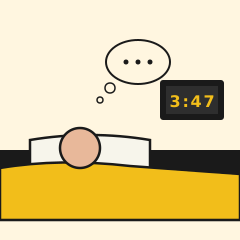
Most people wake briefly several times a night and do not remember it because they fall back to sleep within seconds. The 3am pattern is the one where the brief awakening becomes a long one. Sleep architecture changes across the night: the first half is dominated by deep slow-wave sleep, the second half by REM, which is lighter and more easily disturbed. Brief awakenings between cycles in the second half of the night are normal. What turns a brief awakening into an extended one is usually what happens next. If the mind engages, the cognitive arousal that follows makes returning to sleep difficult, and the pattern takes hold.
Read the full answer →05I sleep 8 hours and still wake up tired: what is going on?
The assumption underneath this question is that sleep produces energy. Eight hours should equal feeling restored. When it does not, something must be wrong with the sleep. The science describes something different. Sleep does not produce energy in any direct sense. Sleep makes it possible for the systems that produce energy to do their work. The energy itself is built during the day, through movement, light exposure, nutrition, hydration, recovery from cognitive load, and social contact. If sleep is intact and the day is depleting, the system can be running on empty no matter how many hours were spent in bed.
Read the full answer →06Does poor sleep cause depression and anxiety, or the other way around?
For a long time, the standard story was one-directional. Anxiety and depression caused sleep problems. Sleep was framed as a symptom. The evidence is more interesting. The relationship is bidirectional, with insomnia predicting later onset of depression and anxiety in people who do not have them yet, and improvements in sleep producing measurable improvements in mood, anxiety, and rumination. The clinical implication is significant. When sleep is poor and mood is low, the order in which they are addressed matters. Sleep is often the more workable starting point.
Read the full answer →07Does alcohol actually help me sleep?
Many people use alcohol to fall asleep, and the evidence on what it does is clear and unflattering. Alcohol initially shortens sleep-onset latency. People do fall asleep faster after drinking, and this is the felt sense that alcohol "helps." It then disrupts the second half of the night. REM sleep is suppressed and delayed. Sleep becomes fragmented. The unrefreshed feeling the next morning is not from drinking too little. It is the second-half disruption catching up with the first-half sedation. Tolerance develops to the sedative effect. The disruption does not develop tolerance.
Read the full answer →08What is CBT-I, and why is sleep hygiene not enough?
Most public sleep advice focuses on sleep hygiene: regular bedtime, cool dark room, no screens, less caffeine. These are sensible. They are not a treatment for chronic insomnia, and the evidence on this is consistent. The first-line treatment for chronic insomnia is cognitive behavioural therapy for insomnia, or CBT-I, a multi-component therapy that includes stimulus control, sleep restriction, cognitive restructuring, and relaxation. The component network meta-analysis evidence shows that these components do specific work that sleep hygiene alone does not. If you have tried sleep hygiene and it has not made a meaningful difference, that is consistent with the broader evidence base on what sleep hygiene alone does and does not do.
Read the full answer →09Are ADHDers actually night owls?
The pattern is well-documented. People with ADHD tend toward later sleep onset, later wake times, and difficulty winding down at night. This is not a preference. It is a circadian phase delay built into the system, and increasingly understood to involve the circadian clock-gene machinery itself, not just patterns of behaviour. Roughly 3 in 4 children and adults with ADHD show a delayed sleep/wake cycle, much more common than in the general population. Standard sleep advice, such as "go to bed at 10pm," is not just hard for ADHDers. It is biologically misaligned for many of them, and chronic attempts to force alignment often produce a secondary insomnia layered on top of the underlying delay.
Read the full answer →10Why did my sleep change in my 40s and 50s?
Sleep changes through mid-life are common and they have several distinct drivers. They tend to be discussed less than they should be, and they are often flattened into "stress" or "ageing" when the actual contributors are more specific. For women, perimenopause is a major and under-recognised driver. For both sexes, age-related changes occur in sleep architecture and timing. Mid-life also brings compounding life load. None of these is failure. They are predictable shifts in the system, and recognising what is actually changing is the beginning of working with it rather than against it.
Read the full answer →Guides
Why we sleep, and what actually happens when you are asleep
What sleep is actually for, and what the brain and body do across a night.
When the bed means everything except sleep
How the bed becomes a cue for wakefulness, and what changes that.
The day is where sleep is made
Why the daytime, not the bedtime, is where most sleep is decided.
When the body is tired but the mind will not switch off
The tired-but-wired pattern, and why effort keeps it running.
Why a consistent wake time matters more than a consistent bedtime
The one timing anchor that does more than any bedtime rule.
Sleep that fits the life you actually have
Working with shift work, parenting, and bodies that do not run to a textbook.
Worksheets
The night-time wind-down
Anxiety at night is anxiety with fewer competitors. This worksheet maps the 90 minutes before bed, so the work is on the anxiety, not on the sleeping.
The daytime audit
Sleep is built across the day. The night is when it shows up. This audit makes the daytime visible, as a description of the day, not a prescription for it.
The wake-time anchor
The body's sleep-wake rhythm has an anchor, and the anchor is wake time, not bedtime. This worksheet holds one thing steady for fourteen days.
Your two-week sleep diary
Tracking your sleep for two weeks shows what one bad night, or one good night, cannot. This is information, not a verdict.
From the blog
Sleep starts in the morning: how the day shapes the night
Sleep hygiene: working with what your body responds to
New writing, once a month
One email a month from Equal Psychology with our newest posts, guides and worksheets.
General information only. This page is general psychoeducation, not a clinical assessment, diagnosis, or treatment. Reading it does not establish a treating relationship. If you would like personalised support, please book a Meet and Greet or speak with your GP. If you are in immediate danger, call 000, or call Lifeline on 13 11 14.