
Working with sleep difficulties in adults.
Sleep difficulties in adults are common and rarely a single problem. The picture might be trouble falling asleep, broken sleep, an early waking that won't budge, or a body that arrives in bed wired and won't switch off. This page covers what it can look like, how we work with it, and how to begin.

Last reviewed
Next review
What it can look like
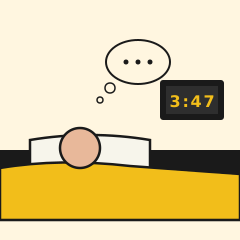
Sleep difficulty is not a single experience. For some people it is initial insomnia: lying down ready for sleep and finding the mind speeds up rather than slowing down. For others it is the 3 a.m. wake-up, eyes open in the dark with no obvious cause and no clear way back. For others again it is fragmented sleep: dropping off easily enough, but never going under deeply enough to wake feeling repaired.
It is also a pattern of chasing, not just lying awake. The early bedtimes hoping to catch up. The naps that protect against the worst days and then sabotage the next night. The mental rehearsal of how tomorrow will go if sleep does not come. The slow narrowing of an evening around the goal of falling asleep, which is one of the things sleep tends to refuse.
Where it tends to overlap with other things
People often arrive describing sleep problems and discover, in the work, that several things are happening at once. Anxiety, depression, ADHD, perimenopause, chronic pain, shift work, and undiagnosed sleep apnoea all change the shape of sleep and what helps. Insomnia and depression in particular travel together: insomnia raises the risk of a later depressive episode, and depression typically disrupts sleep. None of this is to relabel the experience. It is to make sure the work meets what is actually there.
What it costs to keep carrying it
Long-running poor sleep is rarely just an internal problem. Over time it shapes attention, mood, work, relationships, the body, and the sense of what is possible the next day. People often describe a slow narrowing: fewer evenings out, fewer early mornings, fewer demanding tasks attempted before lunch. Recognising the loop is often the first part of changing it: the harder a person tries to fall asleep, the less likely sleep is to come.
Why it is so common, and why that matters
Around 14.8 per cent of Australian adults meet criteria for chronic insomnia disorder, and nearly 60 per cent report at least one sleep symptom three or more times a week. That is not a reassurance about severity. Poor sleep over time has real consequences. But it is a reminder that whatever shape sleep has taken, it is a well-described human pattern, and there are recognised pathways for getting support.
How we work
Time to talk through what brought you in
Like every session, the first is 50 minutes, and it is mostly listening. We map what you are carrying, when it started or worsened, what you have already tried, and what you want from the work. No pressure to commit to a number of sessions.
Individually tailored, paced to you
We work in a way that is individually tailored, drawing on what fits the person and the presentation rather than running everyone through the same protocol. With sleep in particular, the work is often less about adding effort and more about reducing what the mind is doing in service of sleep.
In conversation with your GP
For most people seeing us with sleep difficulty, a GP is part of the picture, both for ruling out medical contributors like sleep apnoea or thyroid issues and, where relevant, for the medication conversation. We write to your GP at the points that matter, with your consent.
Who you would see
Matthew is interested in understanding how a person's whole system works before anything in it is asked to change.

Natalia works to make a first session feel less like an assessment and more like a conversation.
Practical info
Get started →Book a Meet and Greet
A free 15-minute call or in-person meeting, no obligation, to see if we are the right fit before committing to anything. It does not use a Medicare session.
Who this work is for
- Adults (18+) and older adults with chronic insomnia, broken sleep, or non-restorative sleep.
- People who want to work individually and at a pace that fits their current state.
- Those happy to involve a GP for medical screening and, where relevant, a sleep physician.
- People who want a working understanding of why sleep has stopped coming, alongside the work of changing it.
What this work is not
- Crisis support. If you are in crisis, please call 000 or Lifeline 13 11 14.
- A substitute for medical care. Suspected sleep apnoea, thyroid issues, or medication side effects sit with a GP or sleep physician.
- For people under 18. Equal Psychology sees adults and older adults only.
- A guarantee of any specific outcome.
Common questions
All sleep answers →The evidence
The evidence
What this looks like at the population level
Chronic insomnia is among the most common chronic health conditions in Australia. It is more common in women than men, and prevalence rises with age. Insomnia is rarely isolated: short sleep often travels with obstructive sleep apnoea, and around one third of people with sleep apnoea also report insomnia symptoms.
Recent research describes consistent associations between insomnia and later episodes of depression, anxiety, and cardiometabolic disease. None of these associations is the same as cause. They are part of why sleep is rarely treated in isolation.
Therapy as part of a wider system of care
Current Australian general practice guidelines describe cognitive behavioural therapy for insomnia (CBT-I) as the recommended first-line treatment for chronic insomnia, with pharmacotherapy reserved for short-term use or specific situations. CBT-I is typically delivered over four to eight sessions and addresses the behavioural and cognitive patterns that maintain insomnia, alongside any medical contributors managed in primary care.
Care for sleep difficulty often involves more than one person
- Reynolds, A. C., Appleton, S. L., Gill, T. K., & Adams, R. J. (2019). Chronic insomnia disorder in Australia: A report to the Sleep Health Foundation. Sleep Health Foundation. https://www.sleephealthfoundation.org.au/special-sleep-reports/chronic-insomnia-disorder-in-australia
- Appleton, S. L., Reynolds, A. C., Gill, T. K., Melaku, Y. A., & Adams, R. J. (2022). Insomnia prevalence varies with symptom criteria used with implications for epidemiological studies: Role of anthropometrics, sleep habit, and comorbidities. Nature and Science of Sleep, 14, 775–790. https://doi.org/10.2147/NSS.S359437
- Hertenstein, E., Feige, B., Gmeiner, T., Kienzler, C., Spiegelhalder, K., Johann, A., Jansson-Fröjmark, M., Palagini, L., Rücker, G., Riemann, D., & Baglioni, C. (2019). Insomnia as a predictor of mental disorders: A systematic review and meta-analysis. Sleep Medicine Reviews, 43, 96–105. https://doi.org/10.1016/j.smrv.2018.10.006
- Hirshkowitz, M., Whiton, K., Albert, S. M., Alessi, C., Bruni, O., DonCarlos, L., Hazen, N., Herman, J., Katz, E. S., Kheirandish-Gozal, L., Neubauer, D. N., O'Donnell, A. E., Ohayon, M., Peever, J., Rawding, R., Sachdeva, R. C., Setters, B., Vitiello, M. V., Ware, J. C., & Adams Hillard, P. J. (2015). National Sleep Foundation's updated sleep duration recommendations: Final report. Sleep Health, 1(4), 233–243. https://doi.org/10.1016/j.sleh.2015.10.004
Resources
See all →General information only. This page is general psychoeducation, not a clinical assessment, diagnosis, or treatment. Reading it does not establish a treating relationship. Outcomes from psychological therapy vary between people and cannot be guaranteed. If you would like personalised support, please book a Meet and Greet or speak with your GP. If you are in immediate danger, call 000 or Lifeline on 13 11 14.