
Trauma
Plain-language answers, longer reads, and worksheets you can take to a session. Written for adults trying to make sense of what happened, and what it left behind.
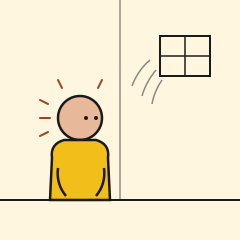
Trauma is not measured by how large the event looks from the outside. It is shaped by what happened, what you were able to do at the time, and whether the experience was met and made sense of afterwards. It can live in the body as much as the memory, in a startle that fires too fast, a numbness that arrives without warning, or a story that will not settle.
The pages below are written for people trying to make sense of what happened, and what it left behind. They are general information, not a clinical assessment. If you would like to talk to one of us, you can start with a Meet and Greet.
Therapy for trauma →Answers, guides and worksheets on Trauma
I want a quick answer
Single questions, plain language, answered in two or three paragraphs.
6 guidesI want to understand
Longer pieces that work through one idea properly.
4 worksheetsI want something to take away
Reflection prompts you can print or open on your phone.
Answers
01"Is there really a difference between Big T and Small T trauma?"
The "Big T" and "small T" distinction is a popular shorthand from the trauma-therapy literature. It captures something real about single-incident versus accumulated experiences, but it has become a hierarchy of legitimacy that the research does not support.
Read the full answer →02"What is developmental trauma?"
Developmental trauma is the impact of repeated or prolonged interpersonal stressors during childhood, occurring in the context of the relationships that were meant to be regulating. It is not the same clinical territory as event-based posttraumatic stress disorder.
Read the full answer →03"What is brainspotting and what happens in a session?"
Brainspotting is a trauma-focused psychotherapeutic modality developed by the American psychologist David Grand in 2003. It works with the visual field, body-based attention, and the therapeutic relationship. The proposed mechanisms remain at the level of hypothesis, and the empirical evidence base is small and emerging.
Read the full answer →04"What is trauma bonding?"
Trauma bonding is a specific relational dynamic that emerges from two structural conditions: a power imbalance and intermittent reinforcement, meaning abuse alternating with affection or repair. The academic literature describes it as documented and recognisable, not as a fuzzy or metaphorical attachment.
Read the full answer →05"Why does talking about my trauma sometimes make it worse?"
When telling the story makes things worse for a while, it is not a sign that you are doing therapy wrong or that the trauma is too much. It is a nervous system event with a documented mechanism.
Read the full answer →06"What is minority stress, and is it different from individual trauma?"
Minority stress is the additional psychological load carried by people in structurally stigmatised groups. It is chronic, socially based, and external in origin. It overlaps with individual trauma in symptom territory but is distinct in source: the load is produced by ongoing social conditions, not by discrete events.
Read the full answer →07"Can it be trauma if it was not life-threatening?"
Yes. The formal DSM-5 criterion for posttraumatic stress disorder requires exposure to actual or threatened death, serious injury, or sexual violence. The clinical reality is that experiences that do not meet this threshold can still produce trauma-related distress and impairment.
Read the full answer →08"Why does my body remember things my mind does not?"
Memory after trauma is often stored unevenly. The body holds patterns of sensation, posture, and physiological response that the conscious mind cannot retrieve as a coherent narrative. This is how the system organised the experience under the conditions it was in, not a sign of malfunction.
Read the full answer →09"How do I know if I have unprocessed trauma?"
Unprocessed trauma is not a condition you can give yourself from a checklist. It is a clinical pattern that requires assessment. There are signs worth taking seriously, and a cleaner question to ask than "do I have unprocessed trauma."
Read the full answer →10"Why do I freeze or shut down when I try to remember?"
Freezing and shutting down are not signs of weakness or avoidance. They are nervous system protective responses that the body has learned to use when the conditions for processing are not in place.
Read the full answer →Guides
The size of trauma is the wrong question
Why what predicts trauma is not the size of the event but what surrounded it.
Developmental trauma is different territory
Why early, repeated harm lands on development itself, not on a single memory.
What brainspotting actually does
A plain account of the approach, its theory, and the honest state of its evidence.
Minority stress is structural, not personal
Why the disproportionate distress is produced by conditions, not by the identity.
The nervous system, and being retraumatised by telling
Why telling the story outside the window of tolerance can re-injure rather than help.
Trauma bonding is not love
The structural conditions that build a bond in abusive relationships.
Worksheets
Grounding anchor card
Grounding is not relaxation. It is a way of telling the body, through the senses, that the danger is not here now.
Preparing for a first session
A first session is not the moment you have to tell your story. It is the moment to see whether this feels like a place you could.
Trigger and response inventory
A trigger is not the event happening again. It is the body recognising a cue and responding as if it were. This inventory names the pattern, from a settled distance.
Window of tolerance map
There is a band of arousal in which a person can stay present and think clearly. Mapping your own edges can make them easier to recognise.
New writing, once a month
One email a month from Equal Psychology with our newest posts, guides and worksheets.
General information only. This page is general psychoeducation, not a clinical assessment, diagnosis, or treatment. Reading it does not establish a treating relationship. If you would like personalised support, please book a Meet and Greet or speak with your GP. If you are in immediate danger, call 000, or call Lifeline on 13 11 14.