
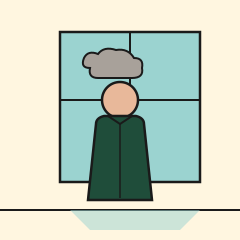
Working with depression in adults.
Depression in adults is rarely one experience. It can be loud and unmissable or quiet and almost invisible, a deep sadness or a flat numbness, a sudden change or a slow drift. This page covers what it can look like, how we work with it, and how to begin.

Last reviewed
Next review
What it can look like
Depression is not a single experience. For some people it is a heavy, weighted sadness that sits in the chest and makes everything feel further away. For others it is not sadness at all, but a flatness: things that used to matter do not register, the day passes without traction, and there is no sharp feeling to point to. For others again, it arrives mostly in the body, as tiredness that does not lift with sleep, a slowed mind, or a steady drop in interest that the person notices only when something they used to look forward to comes and goes without a flicker.
It is also a pattern of doing less, not just feeling less. The activities that used to come easily start to take a disproportionate effort. The reward that should arrive when they are completed lands flat. So the next time, the effort feels less worth it, and a slow withdrawal begins. The shape of depression is more often this loop than a single episode of low mood.
Where it tends to overlap with other things
People often arrive describing depression and discover, in the work, that several things are happening at once. Burnout reads as depression from the outside but does not respond to the same supports. Prolonged grief and chronic stress can both produce a depressed presentation while having their own shape. ADHD, perimenopause, chronic illness, and disrupted sleep all change how depression presents and what helps. None of this is to relabel the experience away from depression. It is to make sure the work meets what is actually there.
What it costs to keep carrying it
Long-term depression is rarely just an internal problem. Over time it shapes work choices, relationships, parenting, sleep, the body, and the sense of what is possible. People often describe a slow narrowing: fewer activities, fewer rooms entered, fewer conversations had, a steady letting-go of things that used to count. Recognising the loop is often the first part of changing it: withdrawal protects in the short term and traps in the long term.
Why it is so common, and why that matters
Around one in six Australian adults have experienced an affective disorder, the category that includes depression, at some point in their lives. That is not a reassurance about severity. Depression can be very serious. But it is a reminder that whatever shape it has taken, it is a well-described human pattern, and there are recognised pathways for getting support.
How we work
Time to talk through what brought you in
Like every session, the first is 50 minutes, and it is mostly listening. We map what you are carrying, when it started or worsened, what you have already tried, and what you want from the work. No pressure to commit to a number of sessions.
Individually tailored, paced to you
We work in a way that is individually tailored, drawing on what fits the person and the presentation rather than running everyone through the same protocol. With depression in particular, the pace matters: when the reward system is muted, small steps land more reliably than large ones.
In conversation with your GP
For most people seeing us with depression, a GP and a Mental Health Treatment Plan are part of the picture. If the question of medication comes up, that conversation sits with a GP or psychiatrist. We write to your GP at the points that matter, with your consent.
Who you would see
Matthew is interested in understanding how a person's whole system works before anything in it is asked to change.

Natalia works to make a first session feel less like an assessment and more like a conversation.
Practical info
Get started →Book a Meet and Greet
A free 15-minute call or in-person meeting, no obligation, to see if we are the right fit before committing to anything. It does not use a Medicare session.
Who this work is for
- Adults (18+) and older adults experiencing depression in any of its forms.
- People who want to work individually and at a pace that matches what is possible right now.
- Those happy to involve a GP, and where relevant, a psychiatrist.
- People who want a working understanding of what is happening alongside the work of changing it.
What this work is not
- Crisis support. If you are in crisis, please call 000 or Lifeline 13 11 14.
- A substitute for medical care. We work alongside GPs and psychiatrists; medication decisions sit with them.
- For people under 18. Equal Psychology sees adults and older adults only.
- A guarantee of any specific outcome.
Common questions
All depression answers →The evidence
The evidence
What this looks like at the population level
Affective disorders, the category that includes depression, are the second most prevalent group of mental health concerns in Australia after anxiety disorders. They are more common in women than men, and most common in younger adults, though they are present at meaningful rates across the lifespan. Depressive episode is the most common single affective disorder, with prevalence rising from 4.1 per cent in 2007 to 4.9 per cent in 2020-2022.
Recent research describes consistent associations between depression and disrupted sleep, reduced workforce participation during episodes, and higher rates of co-occurrence with anxiety, chronic pain, and substance use. None of these associations is the same as cause. They are part of why depression is rarely treated in isolation.
Therapy as part of a wider system of care
Current Australian and international clinical guidelines describe psychological therapy and pharmacotherapy as recommended first-line interventions for adult depression, often delivered in combination and within a stepped care framework that involves GPs and, where appropriate, psychiatrists. The Royal Australian and New Zealand College of Psychiatrists guidelines for mood disorders emphasise treating to remission rather than to partial response, and monitoring trajectory over time rather than at single time points.
Care for depression often involves more than one person
- Australian Bureau of Statistics. (2023). National Study of Mental Health and Wellbeing, 2020–2022. Australian Bureau of Statistics. https://www.abs.gov.au/statistics/health/mental-health/national-study-mental-health-and-wellbeing/latest-release
- Malhi, G. S., Bell, E., Bassett, D., Boyce, P., Bryant, R., Hazell, P., Hopwood, M., Lyndon, B., Mulder, R., Porter, R., Singh, A. B., & Murray, G. (2021). The 2020 Royal Australian and New Zealand College of Psychiatrists clinical practice guidelines for mood disorders. Australian & New Zealand Journal of Psychiatry, 55(1), 7–117. https://doi.org/10.1177/0004867420979353
- National Institute for Health and Care Excellence. (2022). Depression in adults: Treatment and management (NICE Guideline NG222). https://www.nice.org.uk/guidance/ng222
- Cuijpers, P., Karyotaki, E., Harrer, M., & Stikkelbroek, Y. (2023). Individual behavioral activation in the treatment of depression: A meta-analysis. Psychotherapy Research, 33(7), 886–897. https://doi.org/10.1080/10503307.2023.2169823
Resources
See all →General information only. This page is general psychoeducation, not a clinical assessment, diagnosis, or treatment. Reading it does not establish a treating relationship. Outcomes from psychological therapy vary between people and cannot be guaranteed. If you would like personalised support, please book a Meet and Greet or speak with your GP. If you are in immediate danger, call 000 or Lifeline on 13 11 14.