For adults with ADHD who are about to start sessions with a clinician, or thinking about it, and who worry about forgetting what they meant to say once they are in the room. That worry is very common. Preparing is optional, and the prep is for you, not the clinician.
The sheet gives you a few written points to bring, read from or leave at home. It gives your clinician your own description of what is going on, in your words, from the start.
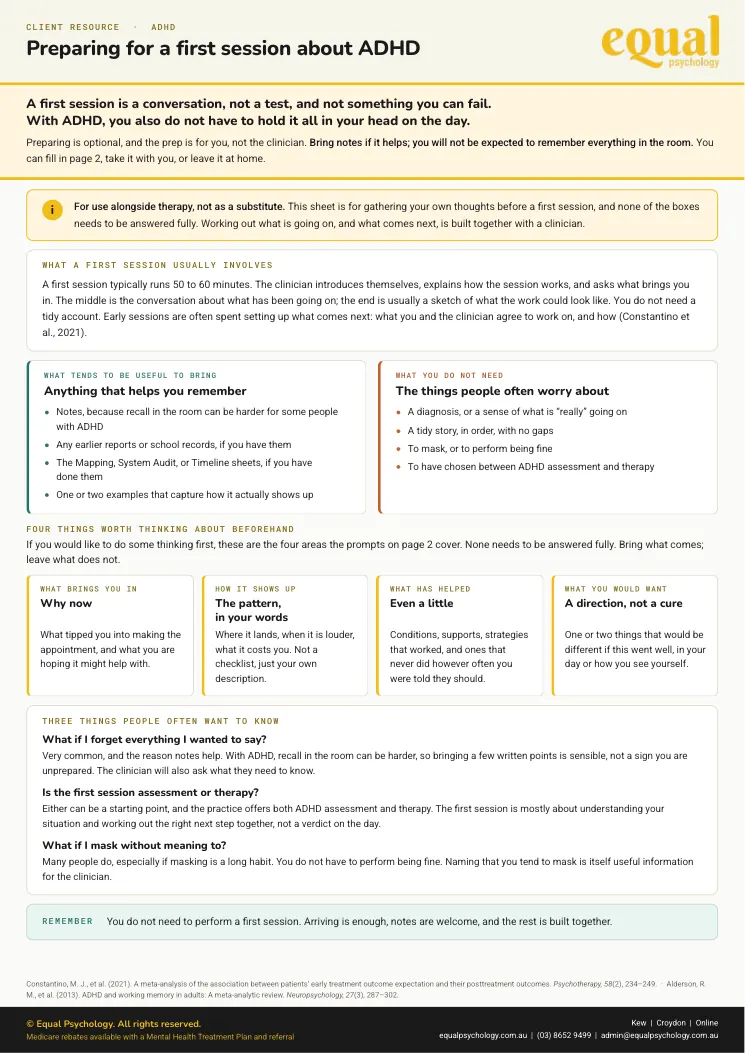
For use alongside therapy, not as a substitute. This sheet is for gathering your own thoughts before a first session, and none of the boxes needs to be answered fully. Working out what is going on, and what comes next, is built together with a clinician.
What is inside
Page 1, read first.What a first session usually involves, what tends to be useful to bring, what you do not need, three questions people often ask, and four areas worth thinking about beforehand:
What brings you in
Why now
How it shows up
The pattern, in your words
What has helped
Even a little
What you would want
A direction, not a cure
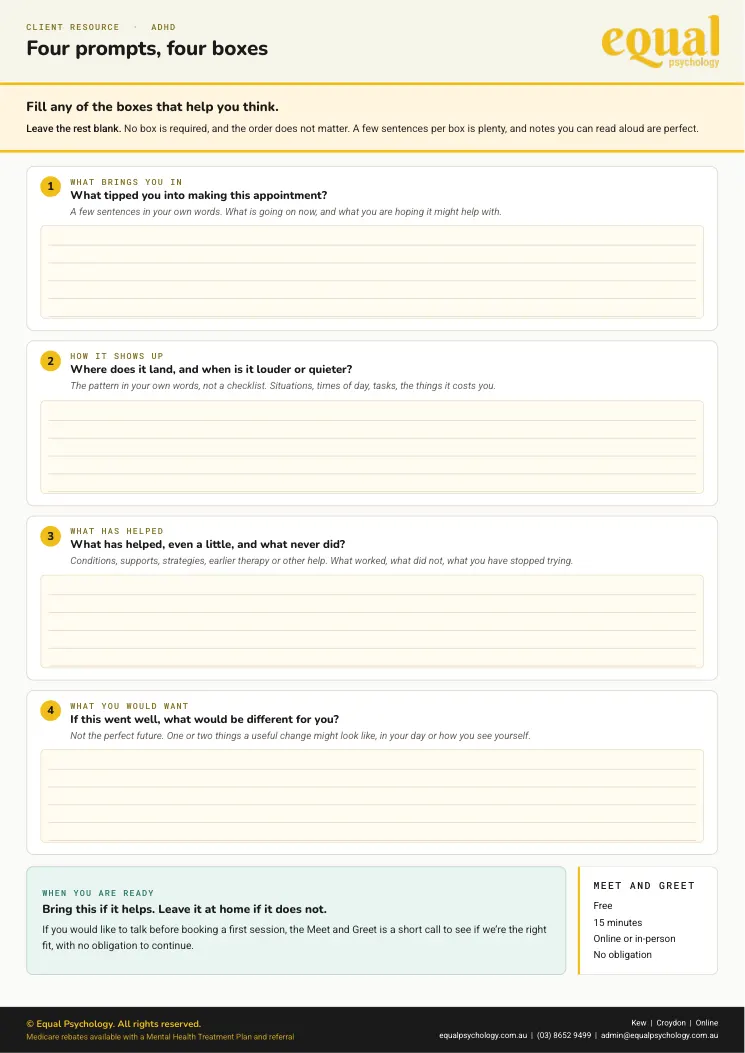
Page 2.Four prompts, four boxes: what brings you in, how it shows up, what has helped, and what you would want. No box is required, and the order does not matter.
Page 1 · Read firstPage 2 · To fill in
How to use it
1Fill only what helpsUse any of the boxes that help you think, in any order, and leave the rest blank.
2Keep it shortA few sentences per box is plenty. Notes you can read aloud are perfect.
3Bring it, or leave itTake the sheet to your first session if it helps, or leave it at home. You will not be expected to remember everything in the room.
You do not need to perform a first session. Arriving is enough, notes are welcome, and the rest is built together. You can type into the PDF on a computer, or print it and write by hand.
One email a month from Equal Psychology with our newest posts, guides and worksheets.
References
Constantino, M. J., et al. (2021). A meta-analysis of the association between patients' early treatment outcome expectation and their posttreatment outcomes. Psychotherapy, 58(2), 234–249.
Alderson, R. M., et al. (2013). ADHD and working memory in adults: A meta-analytic review. Neuropsychology, 27(3), 287–302.
General information only. This worksheet is general psychoeducation, not a clinical assessment, diagnosis, or treatment. Reading it does not establish a treating relationship. If you would like personalised support, please book a Meet and Greet or speak with your GP. If you are in immediate danger, call 000, or call Lifeline on 13 11 14.