For adults with ADHD who have been told, many times, to try harder, be more disciplined or just start. Most people have tried a long list of strategies by now. Some stuck, some never did however often they were recommended, and some got quietly dropped.
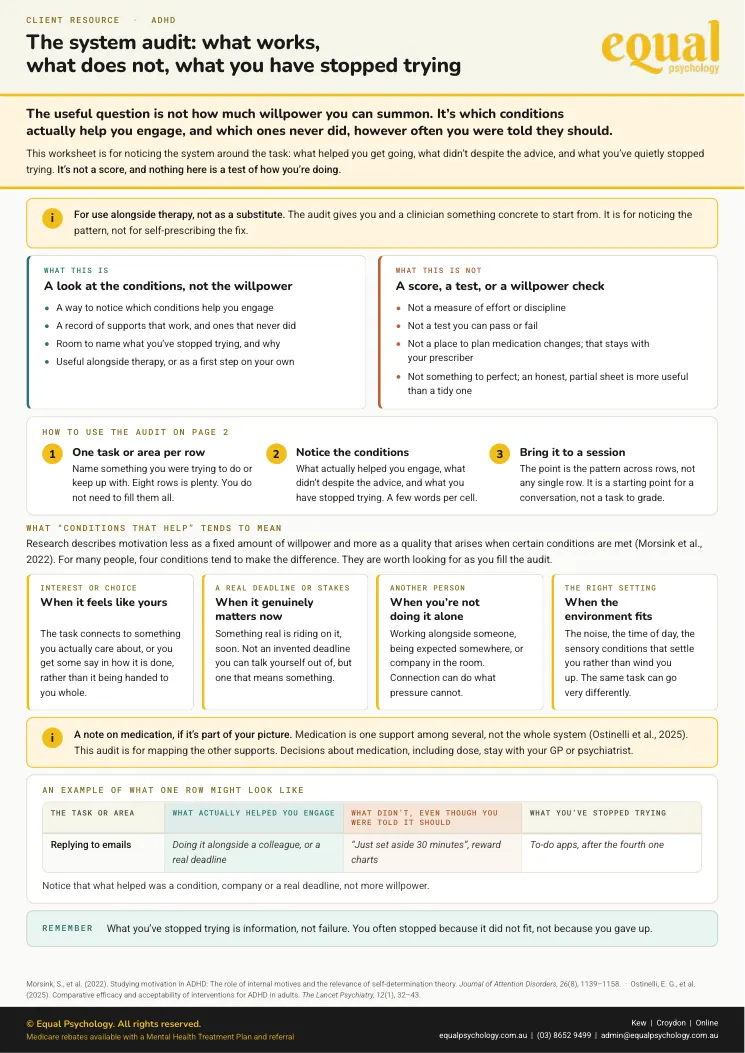
The audit looks at the system around the task rather than the effort. It gives you and your clinician a record of which conditions help you engage, so there is something concrete to start from.
For use alongside therapy, not as a substitute. The audit is for noticing the pattern, not for self-prescribing the fix. Decisions about medication, including dose, stay with your GP or psychiatrist.
What is inside
Page 1, read first.What the audit is and is not, an example row, a note on medication, and four conditions that tend to make the difference:
Interest or choice
When it feels like yours
A real deadline or stakes
When it genuinely matters now
Another person
When you are not doing it alone
The right setting
When the environment fits
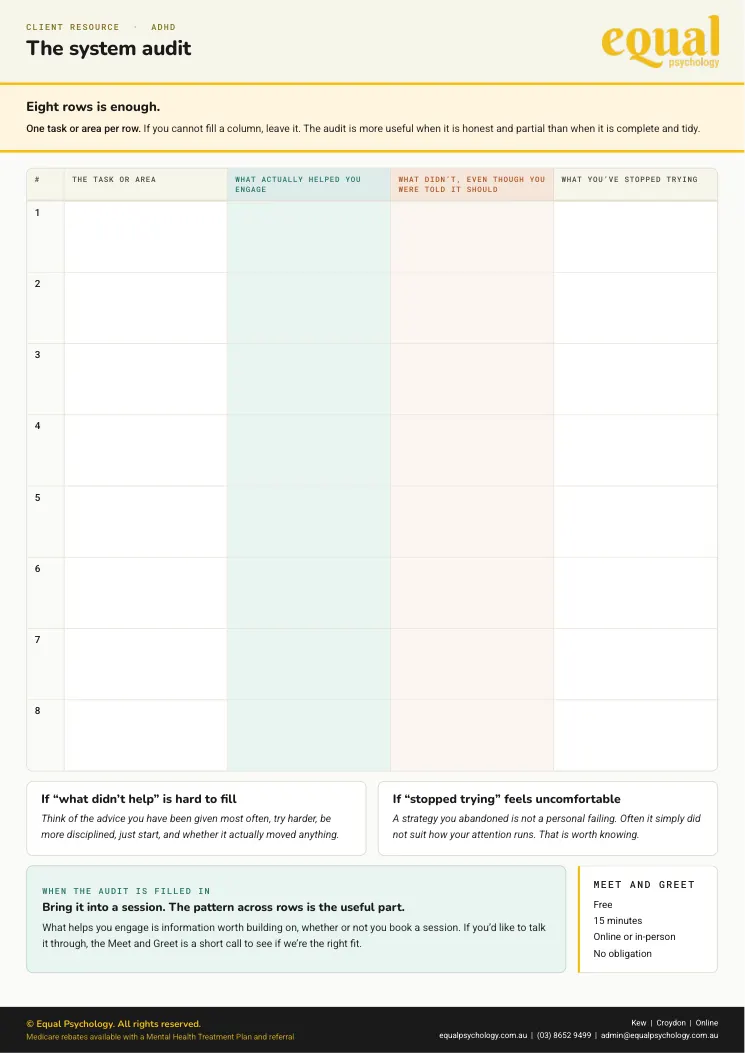
Page 2.Eight rows, one task or area per row: what actually helped you engage, what did not even though you were told it should, and what you have stopped trying. Prompts help when a column is hard to fill.
Page 1 · Read firstPage 2 · To fill in
How to use it
1One task or area per rowName something you were trying to do or keep up with. Eight rows is plenty, and you do not need to fill them all.
2Notice the conditionsWhat actually helped you engage, what did not despite the advice, and what you have stopped trying. A few words per cell.
3Bring it to a sessionThe point is the pattern across rows, not any single row. It is a starting point for a conversation, not a task to grade.
What you have stopped trying is information, not failure. You often stopped because it did not fit, not because you gave up. If you cannot fill a column, leave it. You can type into the PDF on a computer, or print it and write by hand.
Fillable PDF · 2 pages · 270 KB
The system audit: what works, what does not, what you have stopped trying
One email a month from Equal Psychology with our newest posts, guides and worksheets.
References
Morsink, S., et al. (2022). Studying motivation in ADHD: The role of internal motives and the relevance of self-determination theory. Journal of Attention Disorders, 26(8), 1139–1158.
Ostinelli, E. G., et al. (2025). Comparative efficacy and acceptability of interventions for ADHD in adults. The Lancet Psychiatry, 12(1), 32–43.
General information only. This worksheet is general psychoeducation, not a clinical assessment, diagnosis, or treatment. Reading it does not establish a treating relationship. If you would like personalised support, please book a Meet and Greet or speak with your GP. If you are in immediate danger, call 000, or call Lifeline on 13 11 14.