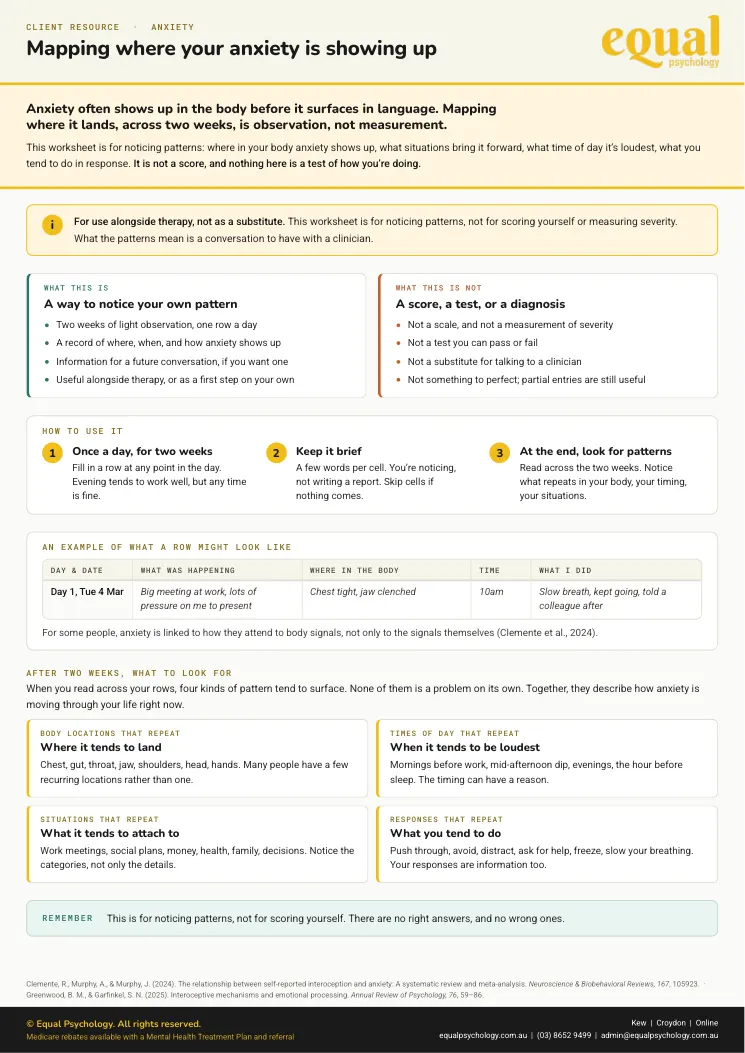
Anxiety often shows up in the body before it surfaces in language. This worksheet maps where it lands across two weeks, as observation, not measurement.
For anyone who feels anxiety in their body but finds it hard to put into words. You might notice a tight chest, a clenched jaw or a knotted stomach, without being sure when it started or what set it off. Anxiety often shows up there first.
The tracker gives you a record of where, when and how anxiety shows up, so you and your clinician have your own pattern to look at. It is not a score or a test, and partial entries are still useful.
For use alongside therapy, not as a substitute. This worksheet is for noticing patterns, not for scoring yourself or measuring severity. What the patterns mean is a conversation to have with a clinician.
What is inside
Page 1, read first.What this worksheet is and is not, an example row, and four kinds of pattern to look for after two weeks:
Body locations
Where it tends to land
Times of day
When it tends to be loudest
Situations
What it tends to attach to
Responses
What you tend to do
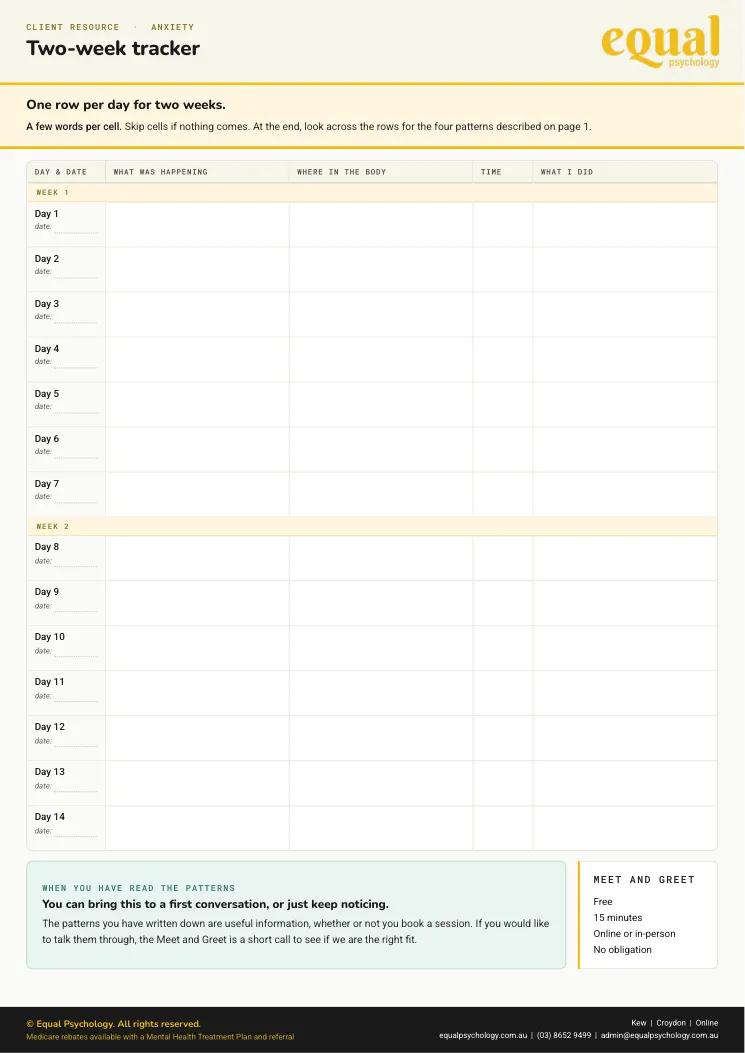
Page 2.A two-week tracker with one row per day: what was happening, where in the body, the time, and what you did.
Page 1 · Read firstPage 2 · To fill in
How to use it
1Once a day, for two weeksFill in a row at any point in the day. Evening tends to work well, but any time is fine.
2Keep it briefA few words per cell. You are noticing, not writing a report. Skip cells if nothing comes.
3Look for patternsAt the end, read across the two weeks. Notice what repeats in your body, your timing and your situations.
There are no right answers, and no wrong ones. You can bring the patterns to a first conversation, or just keep noticing. You can type into the PDF on a computer, or print it and write by hand.
One email a month from Equal Psychology with our newest posts, guides and worksheets.
References
Clemente, R., Murphy, A., & Murphy, J. (2024). The relationship between self-reported interoception and anxiety: A systematic review and meta-analysis. Neuroscience & Biobehavioral Reviews, 167, 105923.
Greenwood, B. M., & Garfinkel, S. N. (2025). Interoceptive mechanisms and emotional processing. Annual Review of Psychology, 76, 59–86.
General information only. This worksheet is general psychoeducation, not a clinical assessment, diagnosis, or treatment. Reading it does not establish a treating relationship. If you would like personalised support, please book a Meet and Greet or speak with your GP. If you are in immediate danger, call 000, or call Lifeline on 13 11 14.