For anyone who has noticed that parts of life have quietly got smaller because of anxiety. Most of what gets called avoidance is reasonable: it protects you from something difficult. The cost is that the difficult thing usually sits next to something you care about, and the avoidance takes both.
The audit helps you see that pattern, so you and your clinician have something concrete to work with. It does not ask you to change anything yet.
For use alongside therapy, not as a substitute. This worksheet is for naming a pattern, not for stepping into what you have been avoiding. The smallest steps belong in a conversation with a clinician.
What is inside
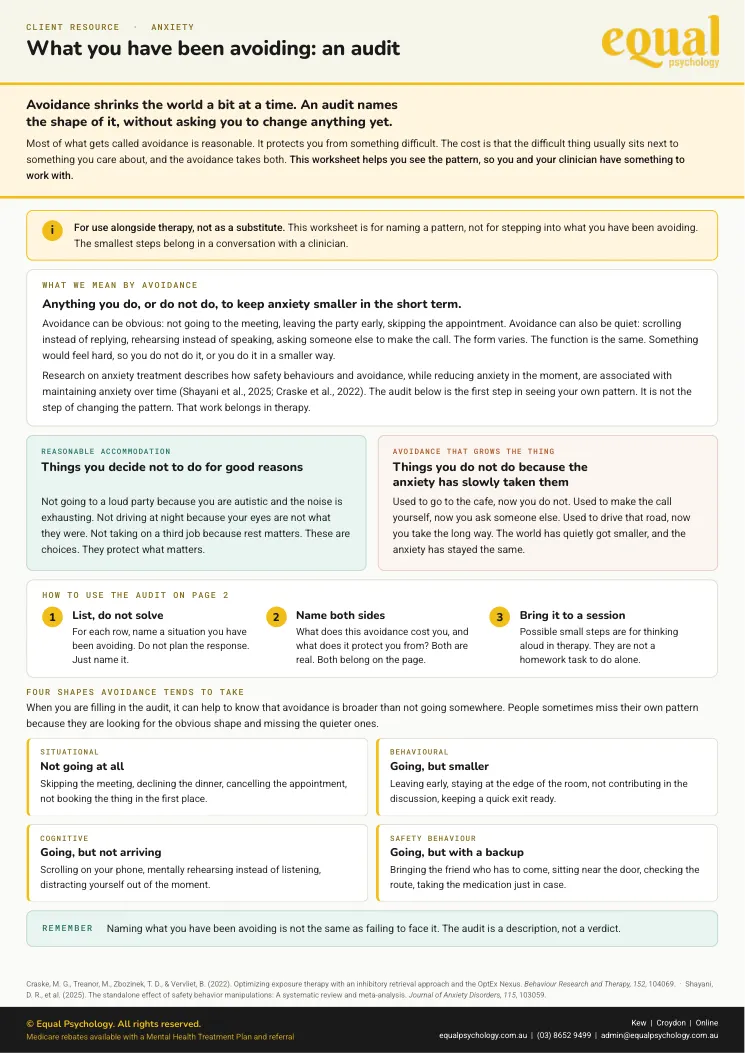
Page 1, read first.What counts as avoidance, the difference between a reasonable choice and avoidance that grows the anxiety, and four shapes avoidance tends to take:
Situational
Not going at all
Behavioural
Going, but smaller
Cognitive
Going, but not arriving
Safety behaviour
Going, but with a backup
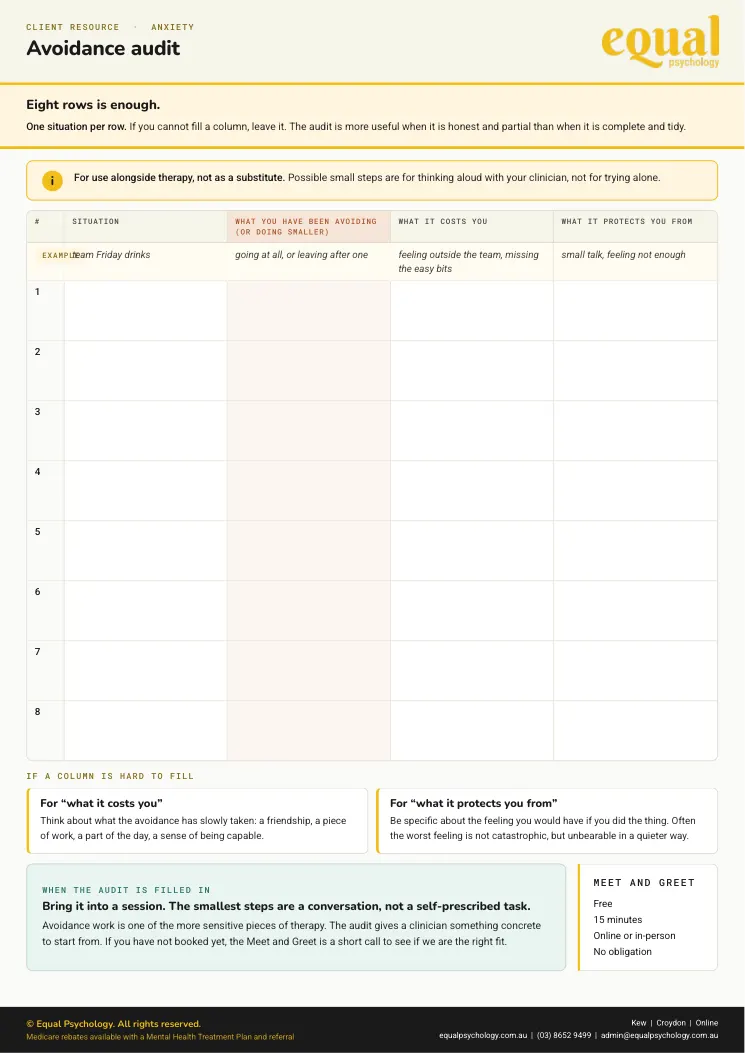
Page 2.Eight rows, one situation per row: what you have been avoiding or doing smaller, what it costs you, and what it protects you from. Prompts help when a column is hard to fill.
Page 1 · Read firstPage 2 · To fill in
How to use it
1List, do not solveFor each row, name a situation you have been avoiding. Do not plan the response. Just name it.
2Name both sidesWhat does this avoidance cost you, and what does it protect you from? Both are real. Both belong on the page.
3Bring it to a sessionTake the filled-in audit to your clinician. The smallest steps are a conversation, not a task to do alone.
The audit is more useful when it is honest and partial than when it is complete and tidy. If you cannot fill a column, leave it. You can type into the PDF on a computer, or print it and write by hand.
One email a month from Equal Psychology with our newest posts, guides and worksheets.
References
Craske, M. G., Treanor, M., Zbozinek, T. D., & Vervliet, B. (2022). Optimizing exposure therapy with an inhibitory retrieval approach and the OptEx Nexus. Behaviour Research and Therapy, 152, 104069.
Shayani, D. R., et al. (2025). The standalone effect of safety behavior manipulations: A systematic review and meta-analysis. Journal of Anxiety Disorders, 115, 103059.
General information only. This worksheet is general psychoeducation, not a clinical assessment, diagnosis, or treatment. Reading it does not establish a treating relationship. If you would like personalised support, please book a Meet and Greet or speak with your GP. If you are in immediate danger, call 000, or call Lifeline on 13 11 14.