For anyone whose anxiety gets louder in the hour or two before bed. During the day, work, conversations and movement absorb some of that activation. At night those fall away, and the same anxiety has less to absorb it.
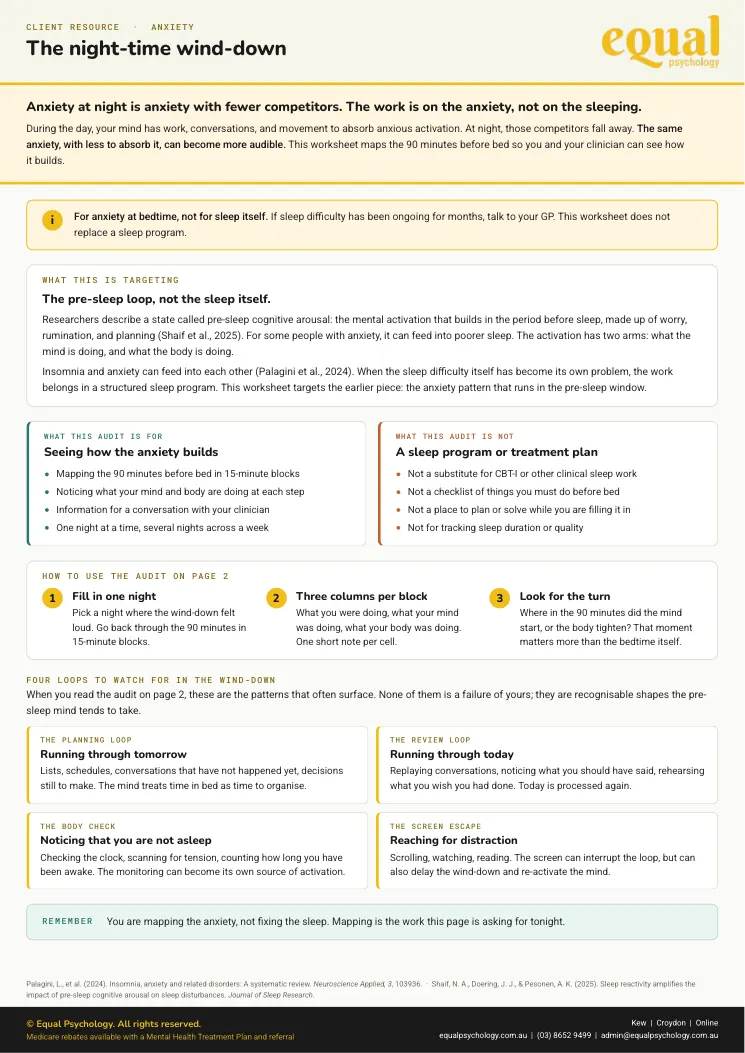
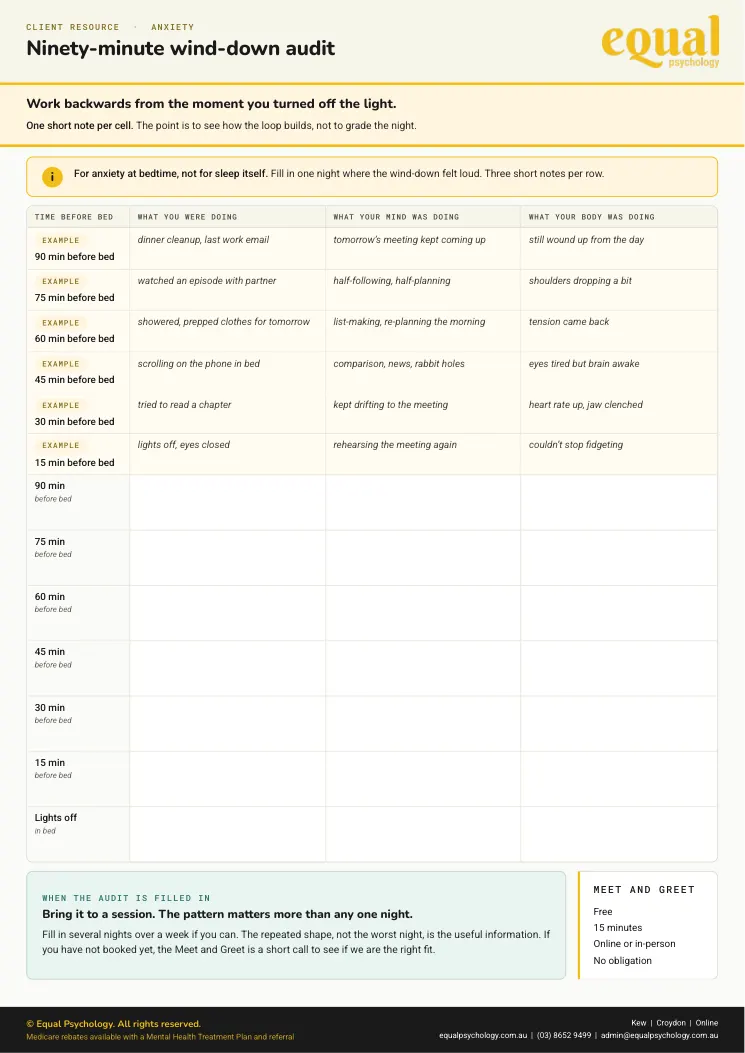
The audit maps the 90 minutes before bed in 15-minute blocks, so you and your clinician can see how the loop builds and where it turns. It is not a checklist of things you must do before bed.
For use alongside therapy, not as a substitute. This worksheet is for anxiety at bedtime, not for sleep itself, and it does not replace a sleep program. If sleep difficulty has been ongoing for months, talk to your GP.
What is inside
Page 1, read first.What the worksheet is targeting, what the audit is and is not for, and four loops to watch for in the wind-down:
The planning loop
Running through tomorrow
The review loop
Running through today
The body check
Noticing that you are not asleep
The screen escape
Reaching for distraction
Page 2.A ninety-minute audit in 15-minute blocks, worked backwards from lights off: what you were doing, what your mind was doing, and what your body was doing. Example notes in each row show the level of detail.
Page 1 · Read firstPage 2 · To fill in
How to use it
1Fill in one nightPick a night where the wind-down felt loud. Go back through the 90 minutes in 15-minute blocks.
2Three columns per blockNote what you were doing, what your mind was doing and what your body was doing. One short note per cell.
3Look for the turnWhere in the 90 minutes did the mind start, or the body tighten? That moment matters more than the bedtime itself.
The point is to see how the loop builds, not to grade the night. If you can, fill in several nights over a week: the repeated shape, not the worst night, is the useful information. You can type into the PDF on a computer, or print it and write by hand.
One email a month from Equal Psychology with our newest posts, guides and worksheets.
References
Palagini, L., et al. (2024). Insomnia, anxiety and related disorders: A systematic review. Neuroscience Applied, 3, 103936.
Shaif, N. A., Doering, J. J., & Pesonen, A. K. (2025). Sleep reactivity amplifies the impact of pre-sleep cognitive arousal on sleep disturbances. Journal of Sleep Research.
General information only. This worksheet is general psychoeducation, not a clinical assessment, diagnosis, or treatment. Reading it does not establish a treating relationship. If you would like personalised support, please book a Meet and Greet or speak with your GP. If you are in immediate danger, call 000, or call Lifeline on 13 11 14.