For anyone who has rested, or taken leave, and found it did not restore what they expected. Not all kinds of rest do the same work, and the balance between what takes from you and what gives back can be hard to see from the inside.
The audit makes that balance visible. It does not tell you what to do. It shows where the imbalance lives, which gives you and your clinician something concrete to look at. It does not require any changes.
For use alongside therapy, not as a substitute. This is a self-noticing tool, not a diagnosis, an assessment or a list of things to start or stop on your own. If the situation is producing more load than recovery can absorb, looking at the situation is work for a conversation with a clinician.
What is inside
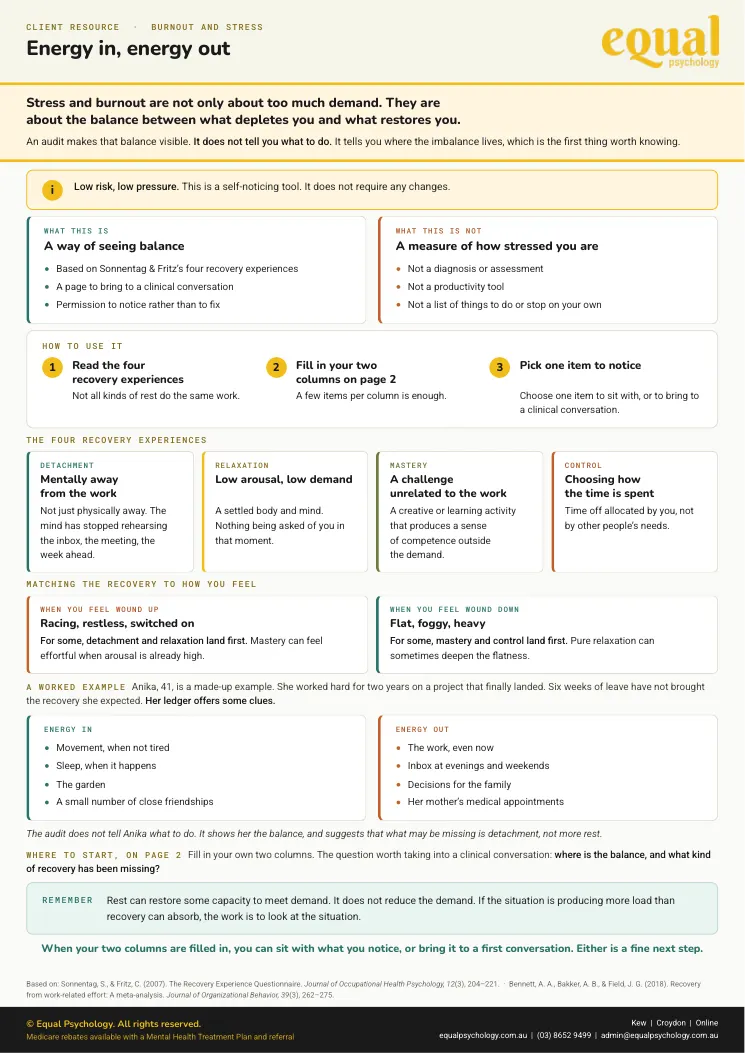
Page 1, read first.Four kinds of recovery experience, how they match feeling wound up or wound down, and a worked example:
Detachment
Mentally away from the work
Relaxation
Low arousal, low demand
Mastery
A challenge unrelated to the work
Control
Choosing how the time is spent
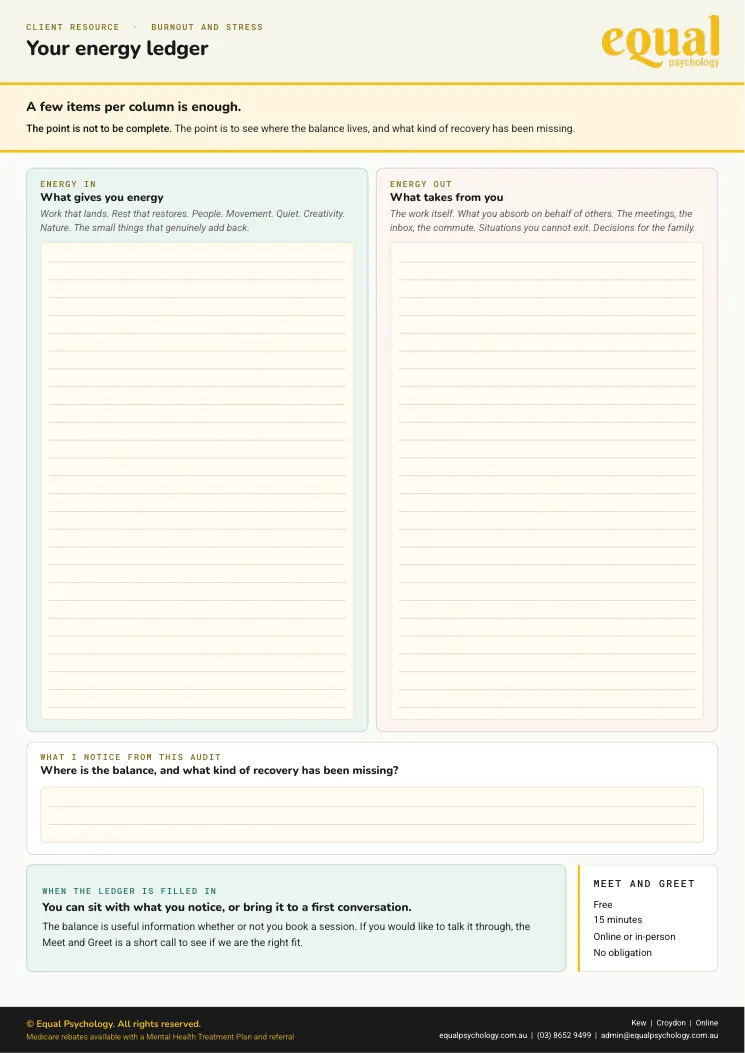
Page 2.Two columns, Energy in (what gives you energy) and Energy out (what takes from you), with prompts in each. A final box asks what you notice: where the balance is, and what kind of recovery has been missing.
Page 1 · Read firstPage 2 · To fill in
How to use it
1Read the four experiencesStart with the four recovery experiences on page 1. Not all kinds of rest do the same work.
2Fill in your two columnsList what gives you energy and what takes from you. A few items per column is enough. The point is not to be complete.
3Pick one item to noticeChoose one item to sit with, or to bring to a clinical conversation.
The audit is permission to notice rather than to fix. You can type into the PDF on a computer, or print it and write by hand.
One email a month from Equal Psychology with our newest posts, guides and worksheets.
References
Sonnentag, S., & Fritz, C. (2007). The Recovery Experience Questionnaire. Journal of Occupational Health Psychology, 12(3), 204–221.
Bennett, A. A., Bakker, A. B., & Field, J. G. (2018). Recovery from work-related effort: A meta-analysis. Journal of Organizational Behavior, 39(3), 262–275.
General information only. This worksheet is general psychoeducation, not a clinical assessment, diagnosis, or treatment. Reading it does not establish a treating relationship. If you would like personalised support, please book a Meet and Greet or speak with your GP. If you are in immediate danger, call 000, or call Lifeline on 13 11 14.