


SearchFor GPs and referrersRoom Rentals
Book a Session
Worksheet · Burnout and stress

Your stress and burnout timeline

Stress and burnout rarely arrive in one moment. They build slowly, in patterns you can recognise but cannot always describe. A timeline can make the pattern easier to see.

Fillable PDF · 2 pages · 224 KB · Free, no sign-up
Written and reviewed by
The Equal Psychology team Matthew Hallam (AHPRA PSY0002471369) · Natalia Cajide (AHPRA PSY0002474316)
Last reviewed
Next review

Who it is for

For anyone whose stress has built over weeks rather than arriving all at once, and who finds it hard to describe how it got here. A single hard week is often what the mind remembers, but the trajectory across recent weeks is often less linear than it feels from the inside.

The timeline sets out what was happening around you alongside what you noticed in yourself, so you and your clinician can see accumulation, recovery and recurrence side by side. What started a stress pattern and what keeps it going are often different.

For use alongside therapy, not as a substitute. This worksheet is heavier than the others and is best done in low-demand time. If looking back brings up more than expected, leave the page, leave blank what feels too much, and bring the partial to a clinical conversation. If things feel worse, or keep getting harder, talk to your GP or clinician.

What is inside

Page 1, read first. Why a timeline is useful, a gentle note on what looking back can bring up, and where to start on page 2.

Page 2. Five points across the last couple of months, from about two months ago to now. For each period, two prompts: what was happening, and what you noticed in yourself. A final box asks what pattern stands out.
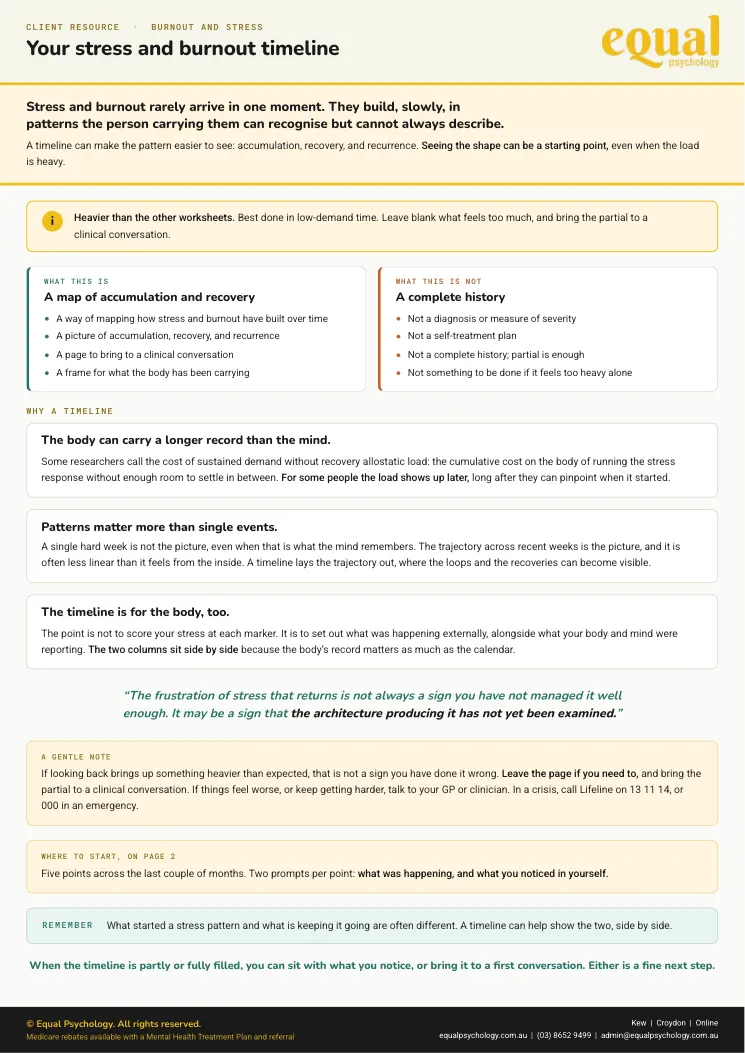
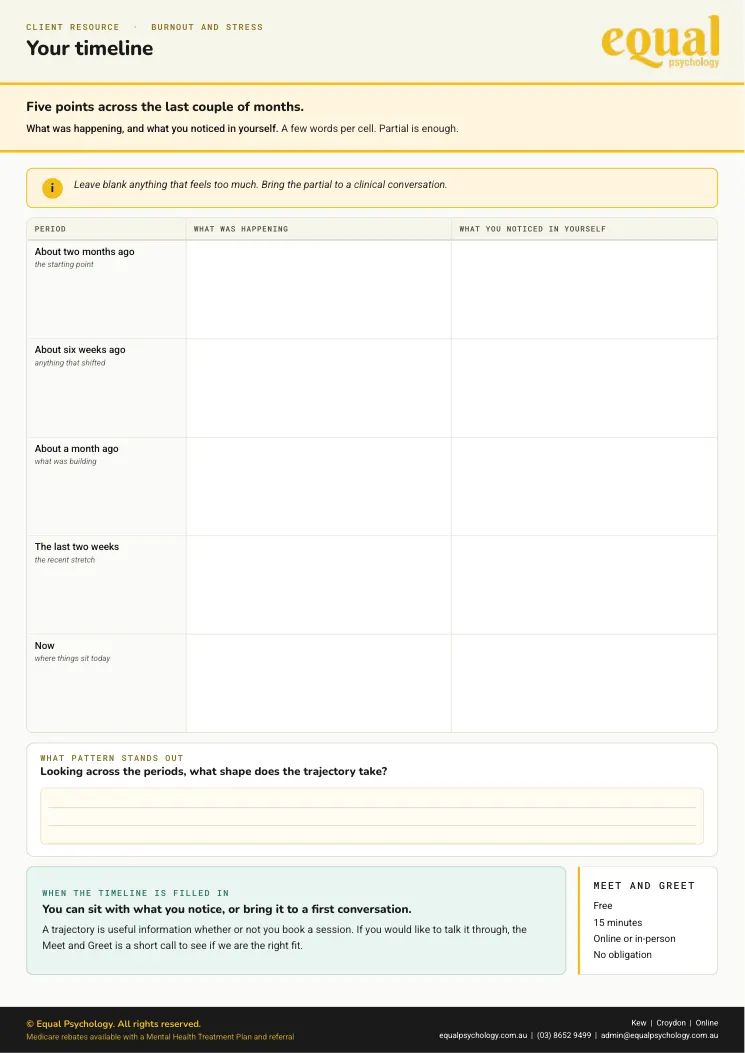
Page 1 of the worksheet Your stress and burnout timeline
Page 1 · Read first
Page 2 of the worksheet Your stress and burnout timeline, the part you fill in
Page 2 · To fill in

How to use it

  1. 1Choose a low-demand timeThis is heavier than the other worksheets. Pick a time when not much else is being asked of you.
  2. 2Fill in both columnsFor each period, write a few words on what was happening and what you noticed in yourself. The point is not to score your stress.
  3. 3Bring the partialLeave blank anything that feels too much. Partial is enough. Bring what you have to a clinical conversation.

The timeline is not a complete history, and it does not need to be. Looking across the periods, notice what shape the trajectory takes. You can type into the PDF on a computer, or print it and write by hand.
Fillable PDF · 2 pages · 224 KB
Your stress and burnout timeline
Download PDF
Therapy at Equal Psychology · Burnout and stressWorking with burnout and stress in adultsWhat burnout and stress can look like, how we work with them, what sessions cost, and how to begin. See how we work with burnout →

General information only. This worksheet is general psychoeducation, not a clinical assessment, diagnosis, or treatment. Reading it does not establish a treating relationship. If you would like personalised support, please book a Meet and Greet or speak with your GP. If you are in immediate danger, call 000, or call Lifeline on 13 11 14.

Therapy at Equal Psychology
Working with burnout and stress in adults
See how we work with burnout →