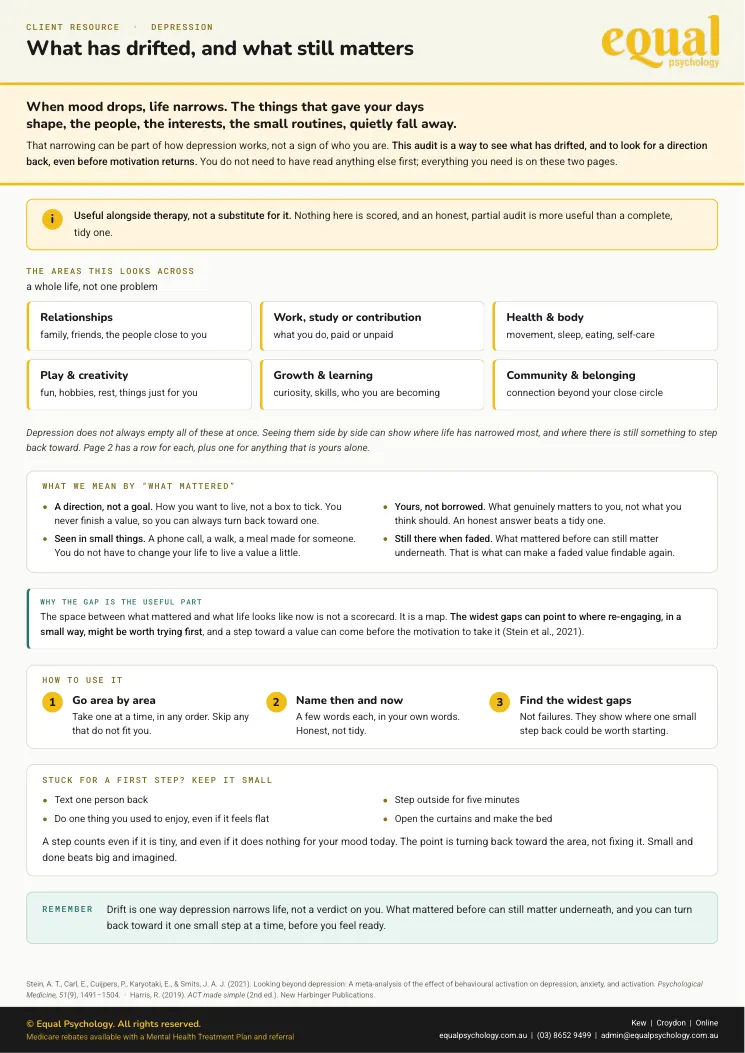
For anyone who has noticed the things that gave their days shape, the people, the interests, the small routines, quietly falling away. That narrowing can be part of how depression works, not a sign of who you are, and what mattered before can still matter underneath.
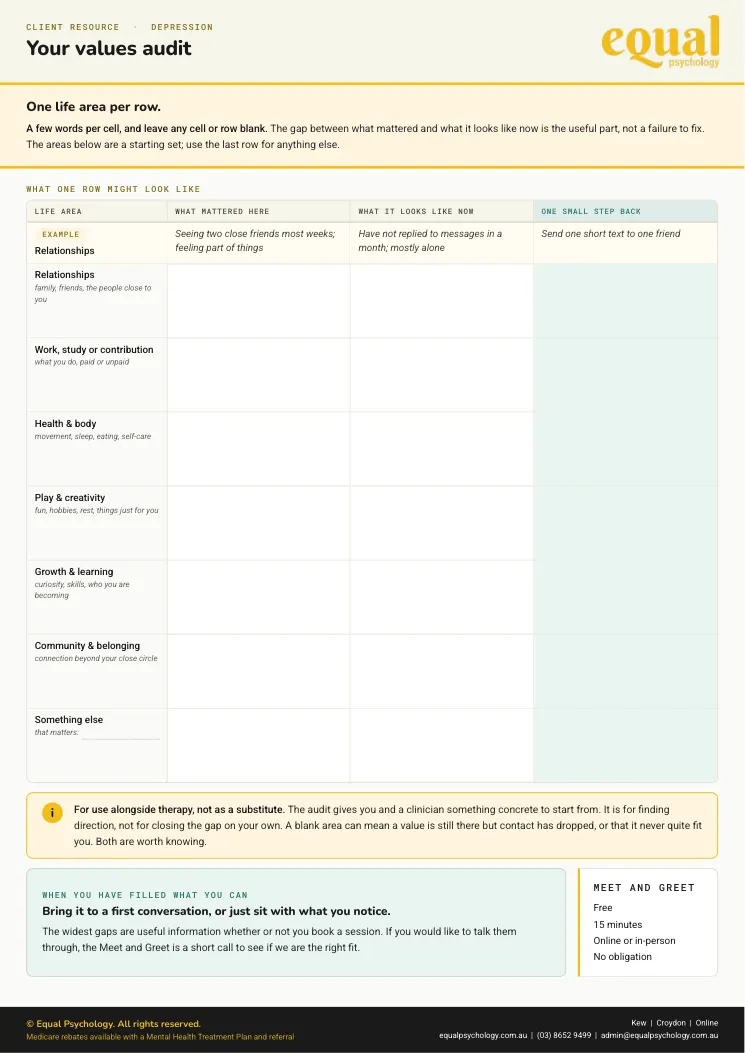
The audit sets what mattered beside what life looks like now, area by area. The gap between them is a map, not a scorecard, and it gives you and your clinician something concrete to start from.
For use alongside therapy, not as a substitute. The audit is for finding direction, not for closing the gap on your own. A blank area can mean a value is still there but contact has dropped, or that it never quite fit you, and both are worth talking through with a clinician.
What is inside
Page 1, read first.What is meant by a value, why the gap is the useful part, and six areas the audit looks across:
Relationships
Family, friends, the people close to you
Work, study or contribution
What you do, paid or unpaid
Health & body
Movement, sleep, eating, self-care
Play & creativity
Fun, hobbies, rest, things just for you
Growth & learning
Curiosity, skills, who you are becoming
Community & belonging
Connection beyond your close circle
Page 2.One life area per row, plus a row for anything else that matters: life area, what mattered here, what it looks like now, and one small step back.
Page 1 · Read firstPage 2 · To fill in
How to use it
1Go area by areaTake one at a time, in any order. Skip any that do not fit you.
2Name then and nowWrite what mattered, then what it looks like now. A few words each, in your own words. Honest, not tidy.
3Find the widest gapsThey are not failures. They show where one small step back could be worth starting. Keep the step small.
Nothing here is scored, and an honest, partial audit is more useful than a complete, tidy one. A step counts even if it is tiny. You can type into the PDF on a computer, or print it and write by hand.
One email a month from Equal Psychology with our newest posts, guides and worksheets.
References
Stein, A. T., Carl, E., Cuijpers, P., Karyotaki, E., & Smits, J. A. J. (2021). Looking beyond depression: A meta-analysis of the effect of behavioural activation on depression, anxiety, and activation. Psychological Medicine, 51(9), 1491–1504.
Harris, R. (2019). ACT made simple (2nd ed.). New Harbinger Publications.
General information only. This worksheet is general psychoeducation, not a clinical assessment, diagnosis, or treatment. Reading it does not establish a treating relationship. If you would like personalised support, please book a Meet and Greet or speak with your GP. If you are in immediate danger, call 000, or call Lifeline on 13 11 14.