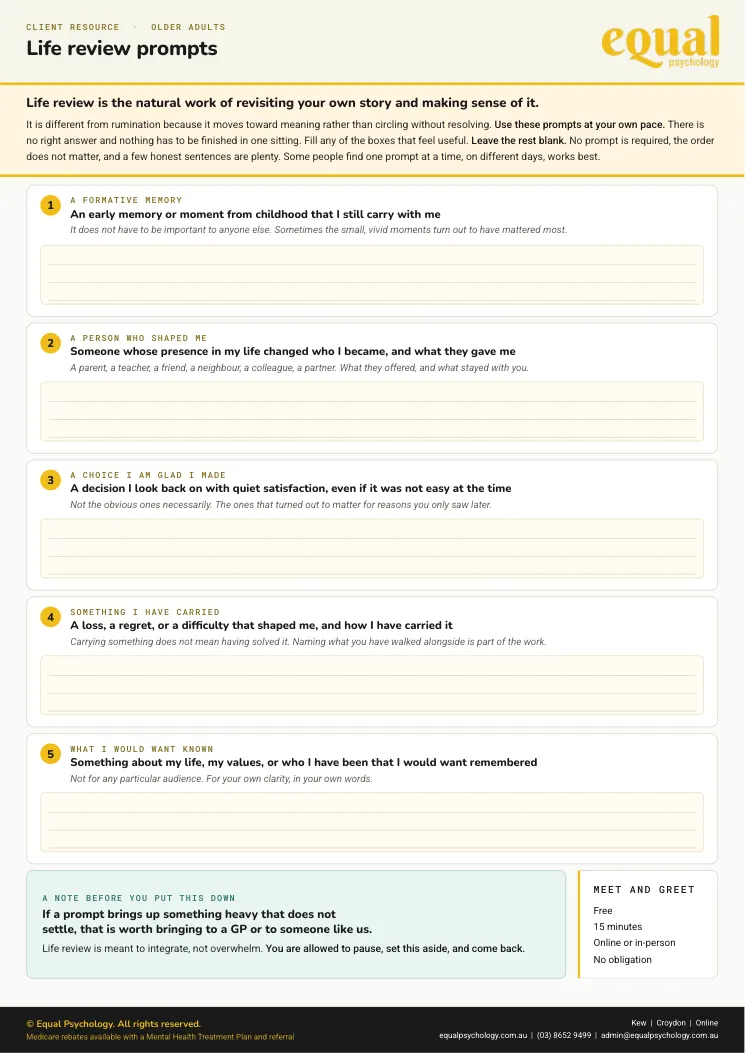
Life review is the natural work of revisiting your own story and making sense of it. These prompts invite you to do that in your own time and your own words.
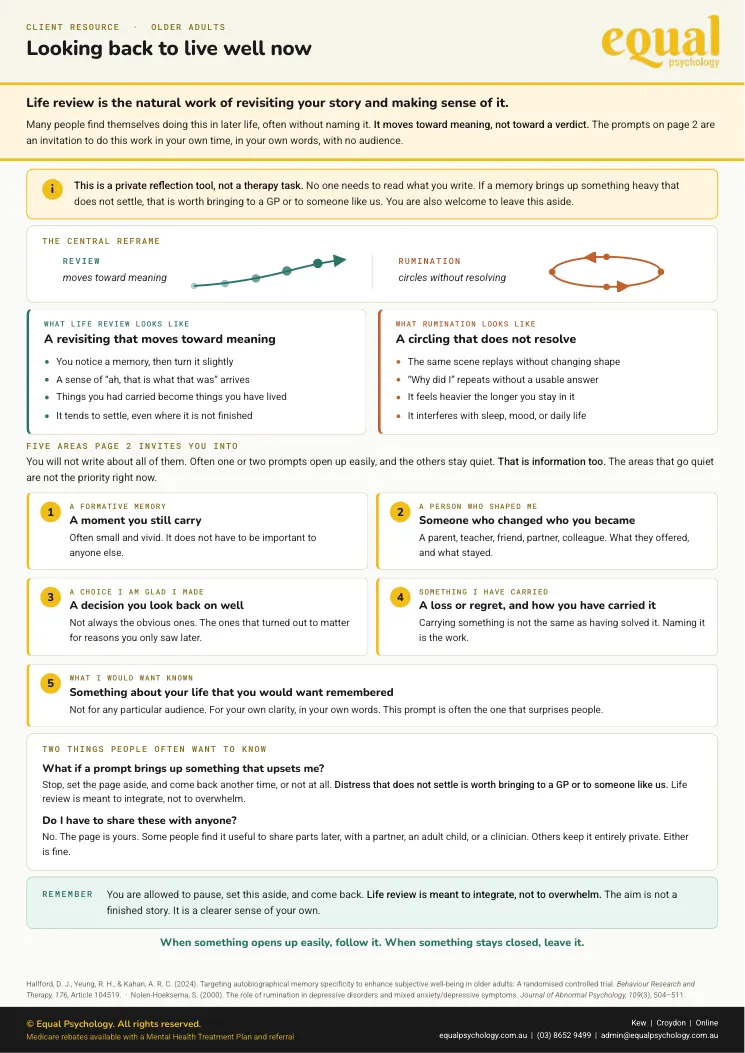
For anyone in later life who finds themselves looking back, at a memory, a person, a choice or a loss, and wanting to make sense of it. Revisiting your story is a natural part of this stage of life. It is different from going over the same ground without getting anywhere, because it moves toward meaning rather than a verdict.
The prompts give you a private place to put a few honest sentences down, at your own pace. No one needs to read what you write. Some people later choose to share parts with a partner, an adult child or a clinician, and others keep it entirely to themselves.
For use alongside therapy, not as a substitute. This is a private reflection tool, not a therapy task, and you are welcome to set it aside at any time. If a memory brings up something heavy that does not settle, that is worth bringing to a GP or to a psychologist.
What is inside
Page 1, read first.How life review differs from rumination, what each tends to look like, and the five areas page 2 invites you into:
A formative memory
A moment you still carry
A person who shaped me
Someone who changed who you became
A choice I am glad I made
A decision you look back on well
Something I have carried
A loss or regret, and how you have carried it
What I would want known
Something you would want remembered
Page 2.Five prompt boxes, each with a short guiding line underneath: a formative memory, a person who shaped me, a choice I am glad I made, something I have carried, and what I would want known.
Page 1 · Read firstPage 2 · To fill in
How to use it
1Start where it opensFill any box that feels useful and leave the rest blank. No prompt is required and the order does not matter.
2Take it slowlyA few honest sentences are plenty. Some people find one prompt at a time, on different days, works best.
3Pause when you need toIf a prompt brings up something that upsets you, stop and set the page aside. Come back another time, or not at all.
The aim is not a finished story. When something opens up easily, follow it. When something stays closed, leave it. You can type into the PDF on a computer, or print it and write by hand.
One email a month from Equal Psychology with our newest posts, guides and worksheets.
References
Hallford, D. J., Yeung, R. H., & Kahan, A. R. C. (2024). Targeting autobiographical memory specificity to enhance subjective well-being in older adults: A randomised controlled trial. Behaviour Research and Therapy, 176, Article 104519.
Nolen-Hoeksema, S. (2000). The role of rumination in depressive disorders and mixed anxiety/depressive symptoms. Journal of Abnormal Psychology, 109(3), 504-511.
General information only. This worksheet is general psychoeducation, not a clinical assessment, diagnosis, or treatment. Reading it does not establish a treating relationship. If you would like personalised support, please book a Meet and Greet or speak with your GP. If you are in immediate danger, call 000, or call Lifeline on 13 11 14.