For anyone whose sleep has been on their mind, and who finds it hard to describe the pattern beyond the last night or two. One rough night tends to colour how the whole week feels. A written record holds the full picture.
The diary gives you a two-week description of your own pattern to bring to whoever helps you with your sleep next. It is not designed for you to diagnose yourself, and partial entries are still useful.
For use alongside therapy, not as a substitute. A diary is a description of your pattern. The interpretation of that pattern belongs in a session with a GP, a psychologist or a sleep clinician.
What is inside
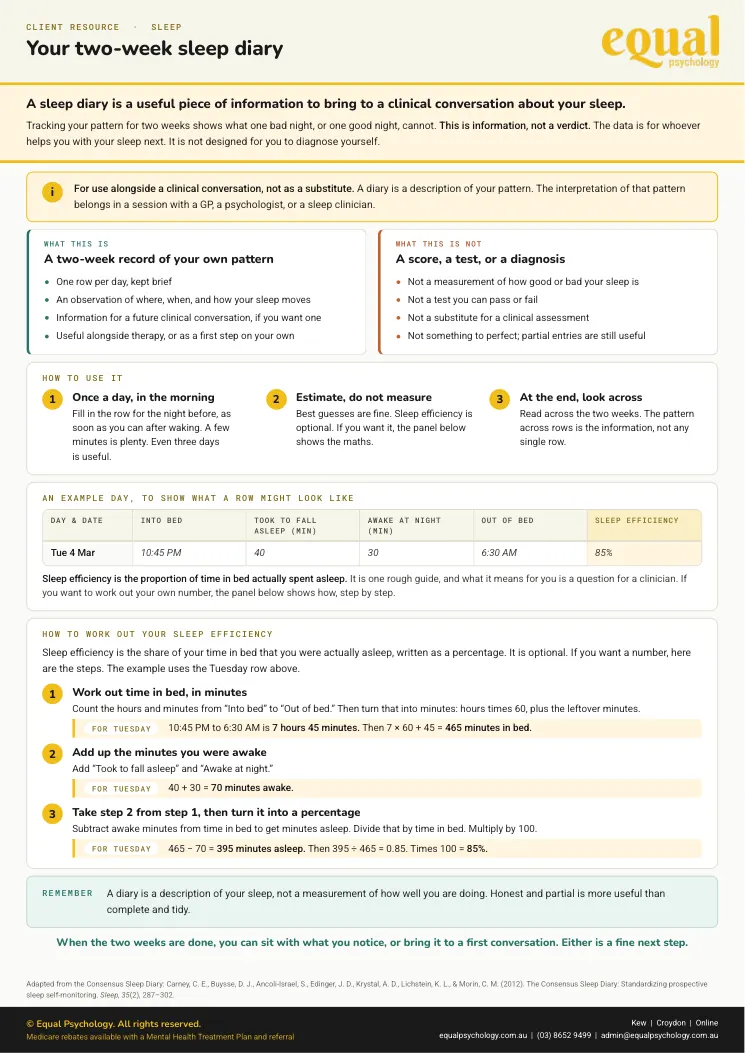
Page 1, read first.What the diary is and is not, an example row, and an optional three-step way to work out your sleep efficiency:
Time in bed
From into bed to out of bed, in minutes
Minutes awake
Took to fall asleep, plus awake at night
Percentage
Minutes asleep, divided by time in bed
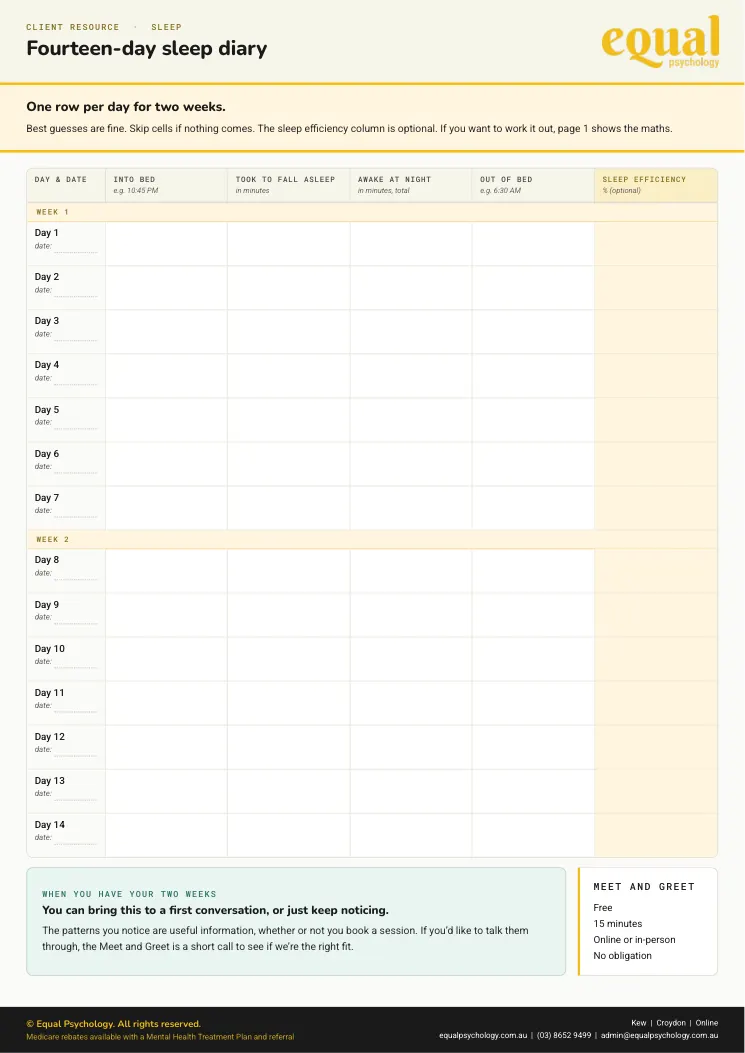
Page 2.A fourteen-day diary with one row per day: into bed, took to fall asleep, awake at night, out of bed, and an optional sleep efficiency column.
Page 1 · Read firstPage 2 · To fill in
How to use it
1Once a day, in the morningFill in the row for the night before, as soon as you can after waking. A few minutes is plenty. Even three days is useful.
2Estimate, do not measureBest guesses are fine. Sleep efficiency is optional. If you want it, page 1 shows how to work it out.
3Look across the rowsAt the end, read across the two weeks. The pattern across rows is the information, not any single row.
Honest and partial is more useful than complete and tidy. When the two weeks are done, you can sit with what you notice, or bring the diary to a first conversation. You can type into the PDF on a computer, or print it and write by hand.
One email a month from Equal Psychology with our newest posts, guides and worksheets.
References
Carney, C. E., Buysse, D. J., Ancoli-Israel, S., Edinger, J. D., Krystal, A. D., Lichstein, K. L., & Morin, C. M. (2012). The Consensus Sleep Diary: Standardizing prospective sleep self-monitoring. Sleep, 35(2), 287–302.
General information only. This worksheet is general psychoeducation, not a clinical assessment, diagnosis, or treatment. Reading it does not establish a treating relationship. If you would like personalised support, please book a Meet and Greet or speak with your GP. If you are in immediate danger, call 000, or call Lifeline on 13 11 14.