For anyone thinking about seeing a clinician after trauma, and wondering what will be expected of them. Opening up happens on your own timescale. For some people the first session means talking, for others it takes time, and both are fine.
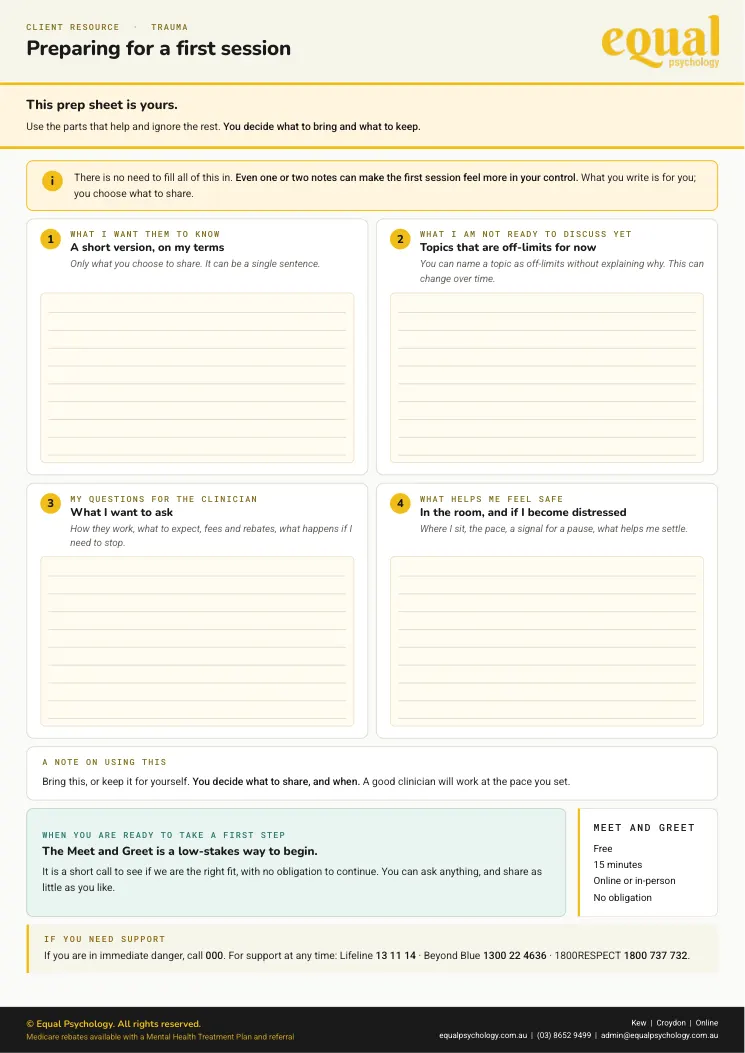
The prep sheet gives you a place to note what you want the clinician to know, what is off-limits for now, your questions, and what helps you feel safe. You decide what to bring and what to keep, and none of it is required.
For use alongside therapy, not as a substitute. This sheet is for preparing, not for writing down what happened. You stay in control of what you share and when, and you can ask questions, say if something does not feel right, or pause and stop at any point.
What is inside
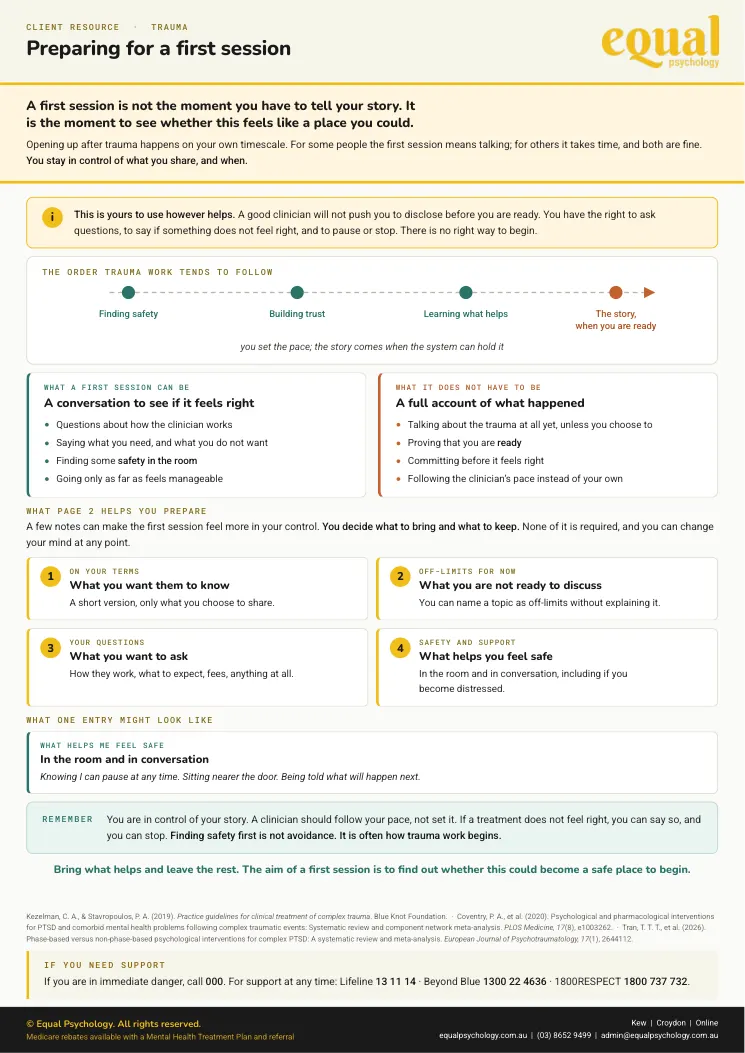
Page 1, read first.What a first session can be and what it does not have to be, and the order trauma work tends to follow:
Finding safety
The first step
Building trust
At your pace
Learning what helps
Before the story
The story
When you are ready
Page 2.Four prompts, each optional: what I want them to know, what I am not ready to discuss yet, my questions for the clinician, and what helps me feel safe, in the room and if I become distressed.
Page 1 · Read firstPage 2 · To fill in
How to use it
1Use only what helpsThere is no need to fill all of this in. Even one or two notes can make the first session feel more in your control.
2Keep it short, on your termsWrite only what you choose to share. It can be a single sentence, and you can name a topic as off-limits without explaining why.
3Bring it, or keep itTake the sheet to the session, or keep it for yourself. A good clinician will work at the pace you set.
Finding safety first is not avoidance. Bring what helps and leave the rest. You can type into the PDF on a computer, or print it and write by hand.
One email a month from Equal Psychology with our newest posts, guides and worksheets.
References
Kezelman, C. A., & Stavropoulos, P. A. (2019). Practice guidelines for clinical treatment of complex trauma. Blue Knot Foundation.
Coventry, P. A., et al. (2020). Psychological and pharmacological interventions for PTSD and comorbid mental health problems following complex traumatic events: Systematic review and component network meta-analysis. PLOS Medicine, 17(8), e1003262.
Tran, T. T. T., et al. (2026). Phase-based versus non-phase-based psychological interventions for complex PTSD: A systematic review and meta-analysis. European Journal of Psychotraumatology, 17(1), 2644112.
General information only. This worksheet is general psychoeducation, not a clinical assessment, diagnosis, or treatment. Reading it does not establish a treating relationship. If you would like personalised support, please book a Meet and Greet or speak with your GP. If you are in immediate danger, call 000, or call Lifeline on 13 11 14.