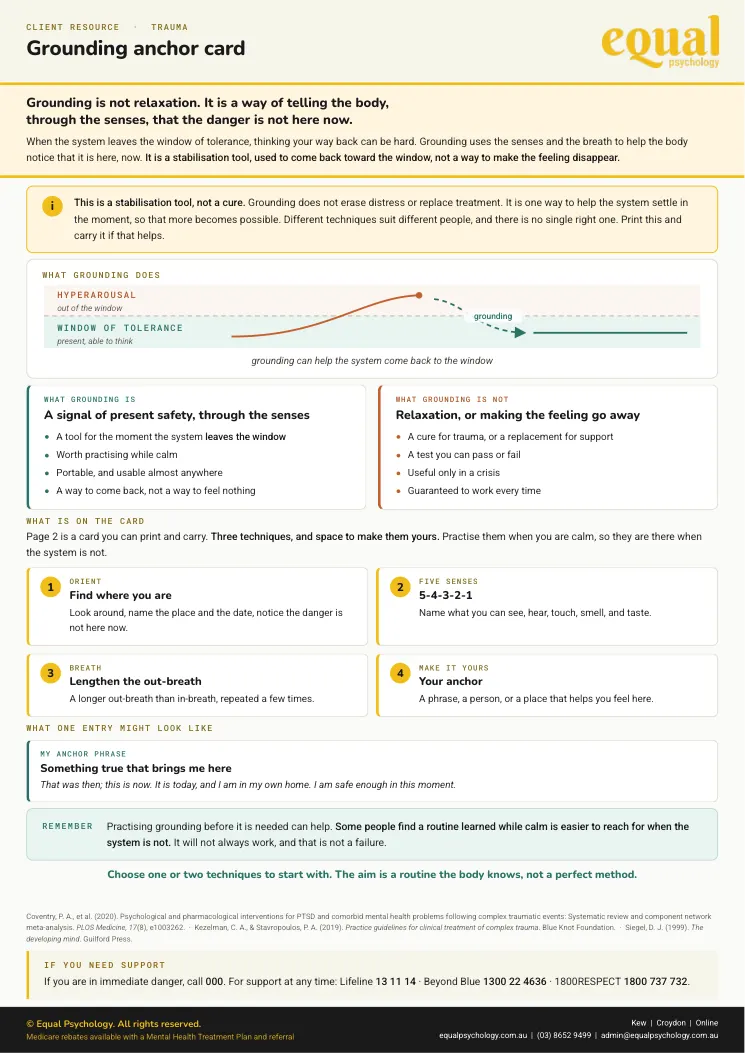
For anyone whose system sometimes leaves the window of tolerance, when thinking your way back can be hard. Grounding is not about making the feeling disappear. It is a way to come back toward the window, using the senses and the breath.
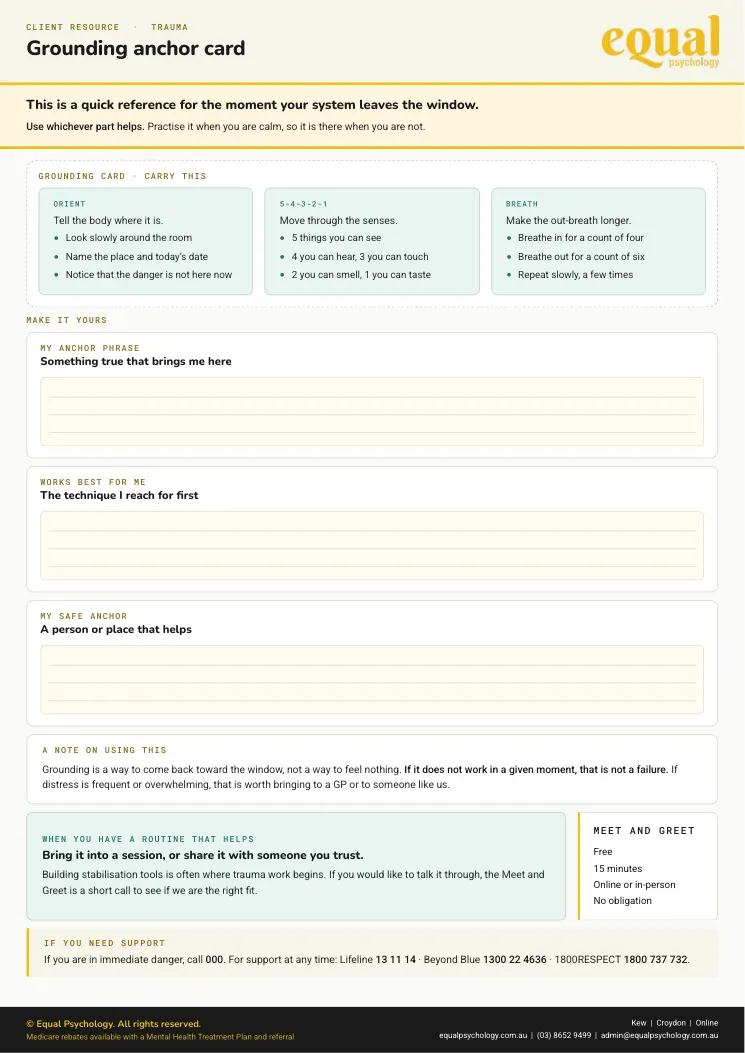
The card gives you three techniques in one place, with space to make them your own. Practised while calm, it can become a routine you can bring into a session or share with someone you trust.
For use alongside therapy, not as a substitute. This card is a stabilisation tool for the moment, not a cure: it does not replace treatment, and if it does not work in a given moment, that is not a failure. If distress is frequent or overwhelming, bring it to a GP or a psychologist, and if you are in immediate danger, call 000.
What is inside
Page 1, read first.What grounding is and is not, how it can help the system come back toward the window of tolerance, and the four parts of the card:
Orient
Find where you are
Five senses
5-4-3-2-1
Breath
Lengthen the out-breath
Make it yours
Your anchor
Page 2.A card to print and carry, with three techniques: Orient, 5-4-3-2-1 and Breath. Below it, space to write your anchor phrase, the technique that works best for you, and your safe anchor, a person or place that helps.
Page 1 · Read firstPage 2 · To fill in
How to use it
1Start with one or twoChoose one or two techniques to begin with. The aim is a routine the body knows, not a perfect method.
2Practise while calmRun through the card when you are settled, so it is there when the system is not.
3Make it yoursWrite an anchor phrase, the technique you reach for first, and a person or place that helps you feel here.
Different techniques suit different people, and there is no single right one. Print the card and carry it if that helps. You can type into the PDF on a computer, or print it and write by hand.
One email a month from Equal Psychology with our newest posts, guides and worksheets.
References
Coventry, P. A., et al. (2020). Psychological and pharmacological interventions for PTSD and comorbid mental health problems following complex traumatic events: Systematic review and component network meta-analysis. PLOS Medicine, 17(8), e1003262.
Kezelman, C. A., & Stavropoulos, P. A. (2019). Practice guidelines for clinical treatment of complex trauma. Blue Knot Foundation.
Siegel, D. J. (1999). The developing mind. Guilford Press.
General information only. This worksheet is general psychoeducation, not a clinical assessment, diagnosis, or treatment. Reading it does not establish a treating relationship. If you would like personalised support, please book a Meet and Greet or speak with your GP. If you are in immediate danger, call 000, or call Lifeline on 13 11 14.