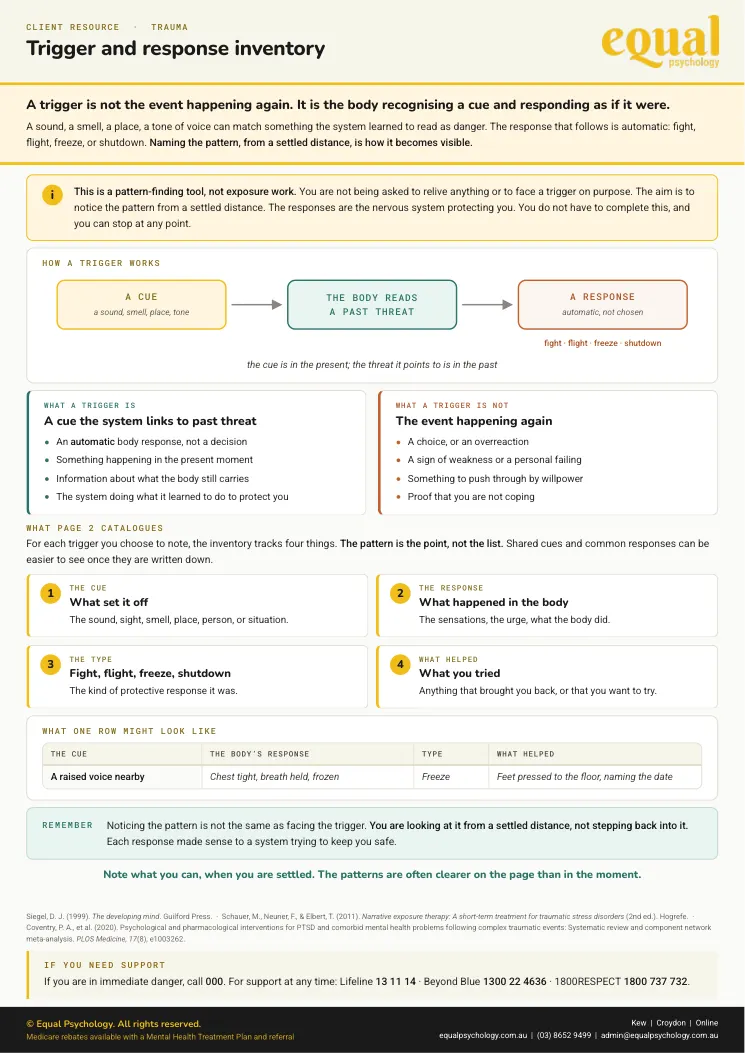
A trigger is not the event happening again. It is the body recognising a cue and responding as if it were. This inventory names the pattern, from a settled distance.
For anyone who has noticed a sound, a smell, a place or a tone of voice set off a response they did not choose. That response is not a weakness or an overreaction. It is the system doing what it learned to do to protect you.
The inventory gives you a catalogue of the triggers you choose to note, so shared cues and common responses can become easier to see. It is useful information to bring into a session, or to share with someone you trust.
For use alongside therapy, not as a substitute. This is a pattern-finding tool, not exposure work: you are not being asked to relive anything or face a trigger on purpose, and there is no need to include your most difficult triggers. You can stop at any point, and if cataloguing these brings up more than feels manageable, bring it to a GP or a psychologist.
What is inside
Page 1, read first.What a trigger is and is not, and how a trigger works, in three parts:
A cue
A sound, smell, place, tone
The body reads
A past threat
A response
Automatic, not chosen
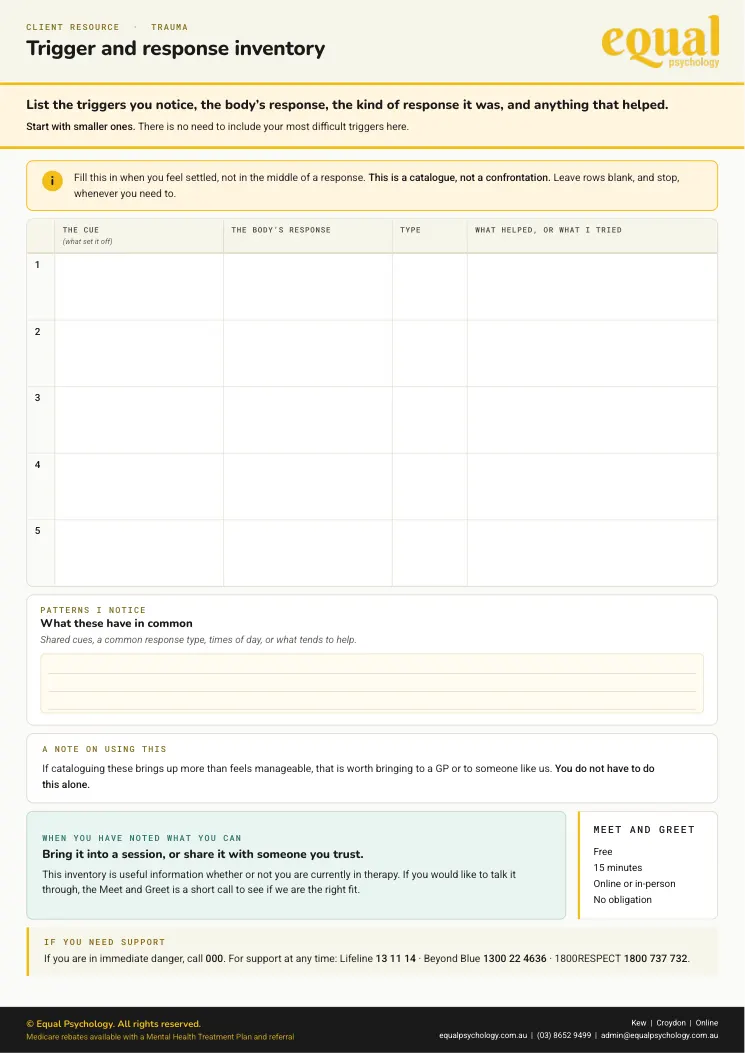
Page 2.Five rows, one trigger per row: the cue (what set it off), the body's response, the type, and what helped, or what I tried. Below the table, space for patterns I notice.
Page 1 · Read firstPage 2 · To fill in
How to use it
1Fill it in when settledUse the inventory when you feel settled, not in the middle of a response. This is a catalogue, not a confrontation.
2Start with smaller onesNote smaller triggers first. There is no need to include your most difficult triggers here.
3Look for the patternNote what the entries have in common: shared cues, a common response type, times of day, or what tends to help.
The pattern is the point, not the list. Leave rows blank, and stop, whenever you need to. You can type into the PDF on a computer, or print it and write by hand.
One email a month from Equal Psychology with our newest posts, guides and worksheets.
References
Siegel, D. J. (1999). The developing mind. Guilford Press.
Schauer, M., Neuner, F., & Elbert, T. (2011). Narrative exposure therapy: A short-term treatment for traumatic stress disorders (2nd ed.). Hogrefe.
Coventry, P. A., et al. (2020). Psychological and pharmacological interventions for PTSD and comorbid mental health problems following complex traumatic events: Systematic review and component network meta-analysis. PLOS Medicine, 17(8), e1003262.
General information only. This worksheet is general psychoeducation, not a clinical assessment, diagnosis, or treatment. Reading it does not establish a treating relationship. If you would like personalised support, please book a Meet and Greet or speak with your GP. If you are in immediate danger, call 000, or call Lifeline on 13 11 14.