For anyone who notices they sometimes feel too much, racing and on guard, or not here, numb and far away. Leaving the window is not a failure of will. It is the nervous system protecting you, and it is not possible for anyone to stay inside the window at all times.
The map gives you a record of your own signs, your early warnings and what helps you come back, in your own words. It is useful information to bring into a session, or to share with someone you trust.
For use alongside therapy, not as a substitute. This is a mapping tool, not a test, and you do not have to share it with anyone. If mapping this brings up more than feels manageable, bring it to a GP or a psychologist: you do not have to do this alone.
What is inside
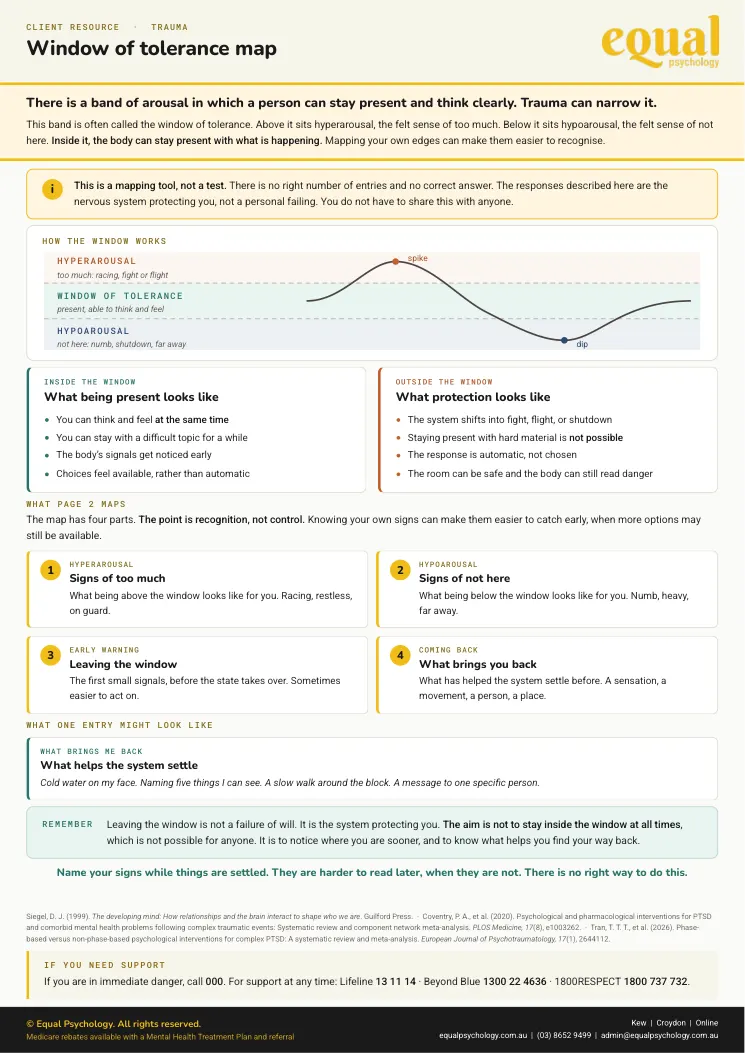
Page 1, read first.How the window of tolerance works, what being inside and outside it looks like, and three zones:
Hyperarousal
Too much: racing, fight or flight
Window of tolerance
Present, able to think and feel
Hypoarousal
Not here: numb, shutdown, far away
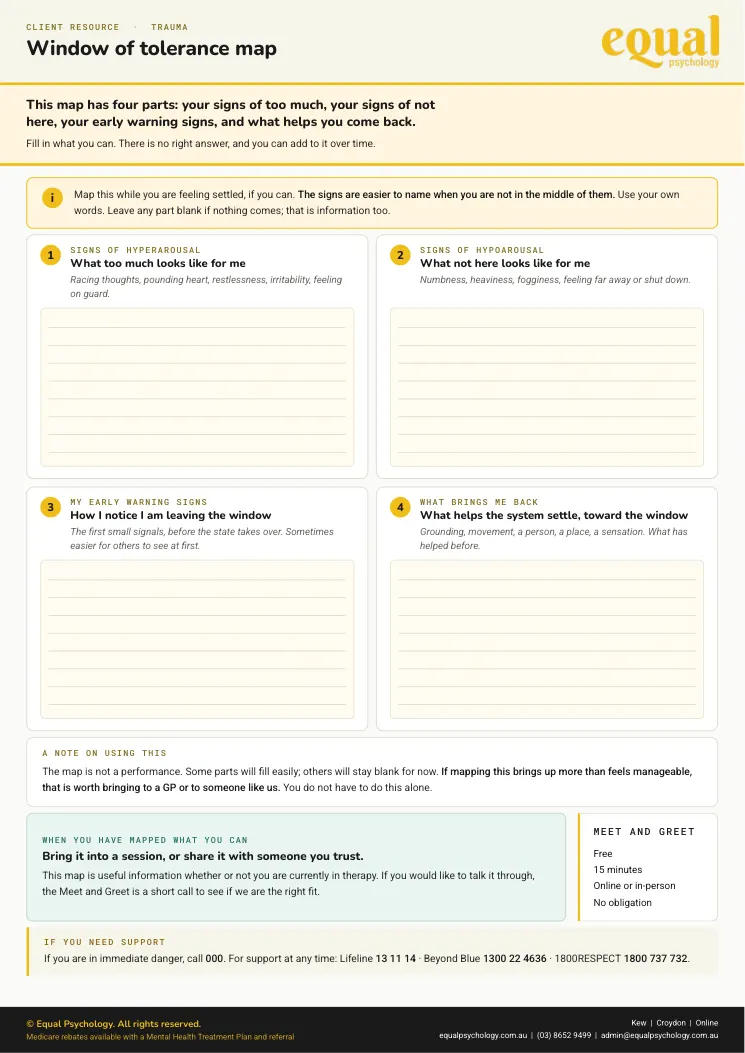
Page 2.Four parts to fill in: signs of hyperarousal, signs of hypoarousal, my early warning signs, and what brings me back. Each has examples to get you started.
Page 1 · Read firstPage 2 · To fill in
How to use it
1Map while settledFill this in while you are feeling settled, if you can. The signs are easier to name when you are not in the middle of them.
2Use your own wordsWrite what too much, not here and leaving the window look like for you. Leave any part blank if nothing comes; that is information too.
3Add to it over timeSome parts will fill easily and others will stay blank for now. Return to the map and bring it into a session if that helps.
The point is recognition, not control. There is no right number of entries and no correct answer. You can type into the PDF on a computer, or print it and write by hand.
One email a month from Equal Psychology with our newest posts, guides and worksheets.
References
Siegel, D. J. (1999). The developing mind: How relationships and the brain interact to shape who we are. Guilford Press.
Coventry, P. A., et al. (2020). Psychological and pharmacological interventions for PTSD and comorbid mental health problems following complex traumatic events: Systematic review and component network meta-analysis. PLOS Medicine, 17(8), e1003262.
Tran, T. T. T., et al. (2026). Phase-based versus non-phase-based psychological interventions for complex PTSD: A systematic review and meta-analysis. European Journal of Psychotraumatology, 17(1), 2644112.
General information only. This worksheet is general psychoeducation, not a clinical assessment, diagnosis, or treatment. Reading it does not establish a treating relationship. If you would like personalised support, please book a Meet and Greet or speak with your GP. If you are in immediate danger, call 000, or call Lifeline on 13 11 14.