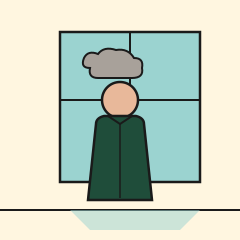

Photograph credit: Image by Gadiel Lazcano on Unsplash
Depression has a way of making life feel smaller.
The book you cannot bring yourself to open. The friend whose message stays unanswered. The shower that takes more from you than it used to. Activities that once felt natural begin to feel like asking a great deal of yourself, and so you ask less.
This is one of the most common patterns in depression, and one of the most misunderstood. It is not laziness, and it is rarely something to push through. It reflects how depression affects the brain systems that organise motivation, energy, and reward, and most evidence-based psychological approaches work with that pattern rather than against it. The rest of this post is about how.
Why does depression lead to withdrawal from life?
Because depression changes how the body answers questions like 'is this worth it?' The systems that organise motivation, energy, and reward, the ones that usually make a hobby feel rewarding or a conversation feel worth picking up, start to operate at a lower level. The reasons are biological as much as psychological.
From the inside, this often feels like effort. The same task that took fifteen minutes a year ago seems to require a great deal of preparation, and once it is done, there is little of the small lift that used to follow. The cost of doing things has gone up, and the reward has gone down. Both at once.
When the cost is high and the return is low, the rational response, in the short term, is to do less. That is what the body does. The trouble is that doing less reduces the input the system needs to recover, and the cycle continues.
Withdrawal in depression is a system response, not a character flaw. The brain systems that organise motivation, energy, and reward operate at a lower level during depression, which makes ordinary activities feel costlier and less rewarding. Working with that system, rather than around it, is what most psychological approaches focus on.
What does the cycle of withdrawal actually look like?
It usually starts quietly. A cancelled plan, then another. A messages list with one or two unread items, then more. The hobby that has not been touched for a fortnight, then a month. The pattern is gradual enough that it is rarely noticed in real time.
Common forms include reduced contact with friends and family, declining invitations more often, finding daily routines harder to keep, putting off small tasks that used to feel manageable, and avoiding messages or calls. Many people also notice anhedonia, a reduction in the pleasure or interest that activities used to bring. The book on the bedside table no longer pulls you in. The music does not land the way it used to.
What makes the cycle persistent is its quiet logic. Each withdrawal makes sense in the moment. Skipping the catch-up because you are tired makes sense. Putting off the email because the words will not come makes sense. Over time, the small avoidances stack up, and the days narrow into something smaller than the life you had before.
The cycle of withdrawal in depression is rarely a single decision. It is a sequence of small, reasonable-feeling choices that gradually shrink the field of activity, which then deprives the brain of the inputs it needs to recover. Recognising the pattern is often the first useful intervention.
What if I don't feel motivated to do anything?
Often, motivation does not come first. This is one of the most counterintuitive findings in depression research, and one of the most clinically useful. In depression, waiting for motivation before acting tends not to work, because the system that produces motivation is the same system that depression has dampened. The instruction to 'get motivated and then do something' is asking the part that is offline to come back online before there is any input to bring it back.
A 2023 meta-analysis of behavioural activation found that structured, gradual increases in meaningful activity were associated with reductions in depressive symptoms across a range of populations (Cuijpers et al., 2023). The mechanism behind behavioural activation, an evidence-based psychological approach for depression, is essentially that pattern: action first, motivation gradually after, in small increments that the system can absorb.
This is not the same as 'just push through it.' It is closer to a careful, deliberate experiment. The question is not 'can I make myself want to do this?' but 'what is the smallest activity I could do today that the body might still register?' That difference is the work.
Motivation in depression often follows action rather than precedes it. Behavioural activation works by reintroducing small, planned activities that the system can absorb, allowing motivation to rebuild gradually (Cuijpers et al., 2023). It is not pushing through. It is starting where the system can still respond.
What kinds of activity actually help?
Activities that tend to help cluster into three categories. They are not new. They are not specific to any particular type of person. They show up across most behavioural activation protocols because they map onto what the brain's reward systems were designed to register.
Pleasure activities create small moments of enjoyment, sensory or otherwise. Music that used to land. A cup of coffee at the window. A short walk through somewhere green. Pleasure activities are not about whether you currently feel pleasure. They are about whether the activity has historically been pleasurable. The body sometimes responds before the felt experience catches up.
Mastery activities create a sense of completion, however small. A drawer organised. A bill paid. A bed made. Mastery activities work on a different reward channel from pleasure activities, which is why both are often included. They tend to rebuild a sense of agency, the sense that what you do still matters and still works.
Connection activities involve another person, even briefly. A short reply to a message. A walk with a friend. A short call to family. Social isolation is one of the most consistent observations in depression research, and connection activities are usually weighted heavily in clinical practice. The picture is not uniform across populations. A 2025 Australian-led systematic review of behavioural activation in adults with co-occurring chronic illness found short-term improvements in depressive symptoms with more uncertain medium-term effects (Yisma et al., 2025), which is a useful reminder that the same principle can need adapting for different bodies.
Activities that tend to help in depression cluster into three categories: pleasure (small enjoyments), mastery (small completions), and connection (small contact with another person). All three are usually weighted, because they activate different parts of the reward system.
How small should the first step be?
Smaller than feels reasonable. The single most common reason behavioural activation does not get off the ground is that the first step is set too large. A walk is too long. A whole afternoon is too much. The bar for the system to respond to a piece of activity in depression is often lower than people expect, and setting it too high is what causes the early discouragement that confirms the depression's narrative.
An example. Instead of 'I need to start exercising again,' the first step is 'I will put on shoes and step outside the door for two minutes.' Instead of 'I should reply to all the messages,' it is 'I will write the first sentence of one reply.' Instead of 'I need to clean the house,' it is 'I will clear one surface.' These are not aspirational miniatures. They are the actual unit of work.
If the first step succeeds, the second step is also small, but a fraction larger. If the first step does not succeed, the next attempt is even smaller. The shape of behavioural activation is not a steep climb. It is a slow ramp with frequent rest landings.
The first step in re-engaging should be smaller than feels reasonable. The activity needs to be small enough that the system can respond to it, not large enough to feel impressive. Two minutes outside, one sentence written, one surface cleared. The bar is responsiveness, not productivity.
What if it has been like this for a while?
Then this is information, and it deserves a response. If low mood, withdrawal, loss of interest, changes in sleep or appetite, or difficulty functioning have continued for several weeks, that is the point at which a conversation with a health professional is reasonable. A GP can rule out medical causes, support a Mental Health Care Plan if appropriate, and connect you with a psychologist or psychiatrist.
Several psychological approaches are recommended for depression in current Australian guidelines. The 2020 Royal Australian and New Zealand College of Psychiatrists clinical practice guidelines for mood disorders (Malhi et al., 2021) describe a stepped approach to care that prioritises psychological treatment, with medication considered alongside or in combination depending on severity. Decisions about treatment are individual and belong to the person and their treating team, not to a blog post.
A 2024 network meta-analysis of treatments for new episodes of depression in adults found that for less severe depression, several psychological approaches showed evidence of benefit; for more severe depression, individual cognitive behavioural therapy and individual behavioural activation were among the most efficacious psychological treatments examined (Mavranezouli et al., 2024). Cost, access, fit with the person, and clinical judgement all sit alongside the evidence in any actual care decision.
Access matters too. Where in-person therapy is hard to begin with, internet-delivered behavioural activation has been shown to be associated with reductions in depressive symptoms (Alber et al., 2023). It is not a substitute for in-person care for everyone, but it is a real first step for some, and it is increasingly part of the stepped-care landscape.
If withdrawal has lasted weeks rather than days, professional support is warranted. Psychological approaches such as behavioural activation and cognitive behavioural therapy are recommended in current Australian clinical practice guidelines for depression (Malhi et al., 2021). The next step is usually a conversation with a GP, not more pressure on yourself.
Re-engaging with life when depressed is not a moral project, and it is not a willpower test. It is the slow work of giving the system enough small, reliable inputs that it can begin to respond to its own life again.
What tends to help is not motivation, not optimism, not 'positive thinking.' It is the willingness to keep the bar low enough that the system can clear it, and to do that often enough that something starts moving. If you are struggling, support is available and you do not need to navigate this alone.
References
Alber, C. S., Krämer, L. V., Rosar, S. M., & Mueller-Weinitschke, C. (2023). Internet-based behavioral activation for depression: A systematic review and meta-analysis. Journal of Medical Internet Research, 25, e41643. https://doi.org/10.2196/41643
Cuijpers, P., Karyotaki, E., Harrer, M., & Stikkelbroek, Y. (2023). Individual behavioral activation in the treatment of depression: A meta-analysis. Psychotherapy Research, 33(7), 886-897. https://doi.org/10.1080/10503307.2023.2197630
Malhi, G. S., Bell, E., Bassett, D., Boyce, P., Bryant, R., Hopwood, M., Lyndon, W., Mulder, R., Porter, R., Singh, A. B., & Murray, G. (2021). The 2020 Royal Australian and New Zealand College of Psychiatrists clinical practice guidelines for mood disorders. Australian & New Zealand Journal of Psychiatry, 55(1), 7-117. https://doi.org/10.1177/0004867420979353
Mavranezouli, I., Megnin-Viggars, O., Pedder, H., Welton, N. J., Dias, S., Watkins, E., Nixon, N., Daly, C. H., Keeney, E., Eadon, H., Caldwell, D. M., O'Donoghue, K. J. M., Stockton, S., Arnold, S., Thomas, J., Kapur, N., & Pilling, S. (2024). A systematic review and network meta-analysis of psychological, psychosocial, pharmacological, physical and combined treatments for adults with a new episode of depression. eClinicalMedicine, 75, 102780. https://doi.org/10.1016/j.eclinm.2024.102780
Yisma, E., Muyambi, K., Walsh, S., Othman, S., Gray, R., Tan, K. L., Steen, M., & Jones, M. (2025). Efficacy and safety of behavioural activation on depression in people with co-occurring non-communicable diseases: Systematic review and meta-analysis. BJPsych Open, 11(2), e70. https://doi.org/10.1192/bjo.2024.870
I write because something in the work asks for language. The people I sit with are often doing more than they realise, in conditions harder than they let themselves admit. If a piece of this has named something you were already feeling, then it has done its work. Whatever you do next is yours.
Natalia Cajide, Registered Psychologist
Would you like to meet Natalia →