
I was listening to a podcast today, and I came across a lovely reflection that has stayed with me. It reminded me of so many conversations I have been having lately about illness, death, and the fear of death.
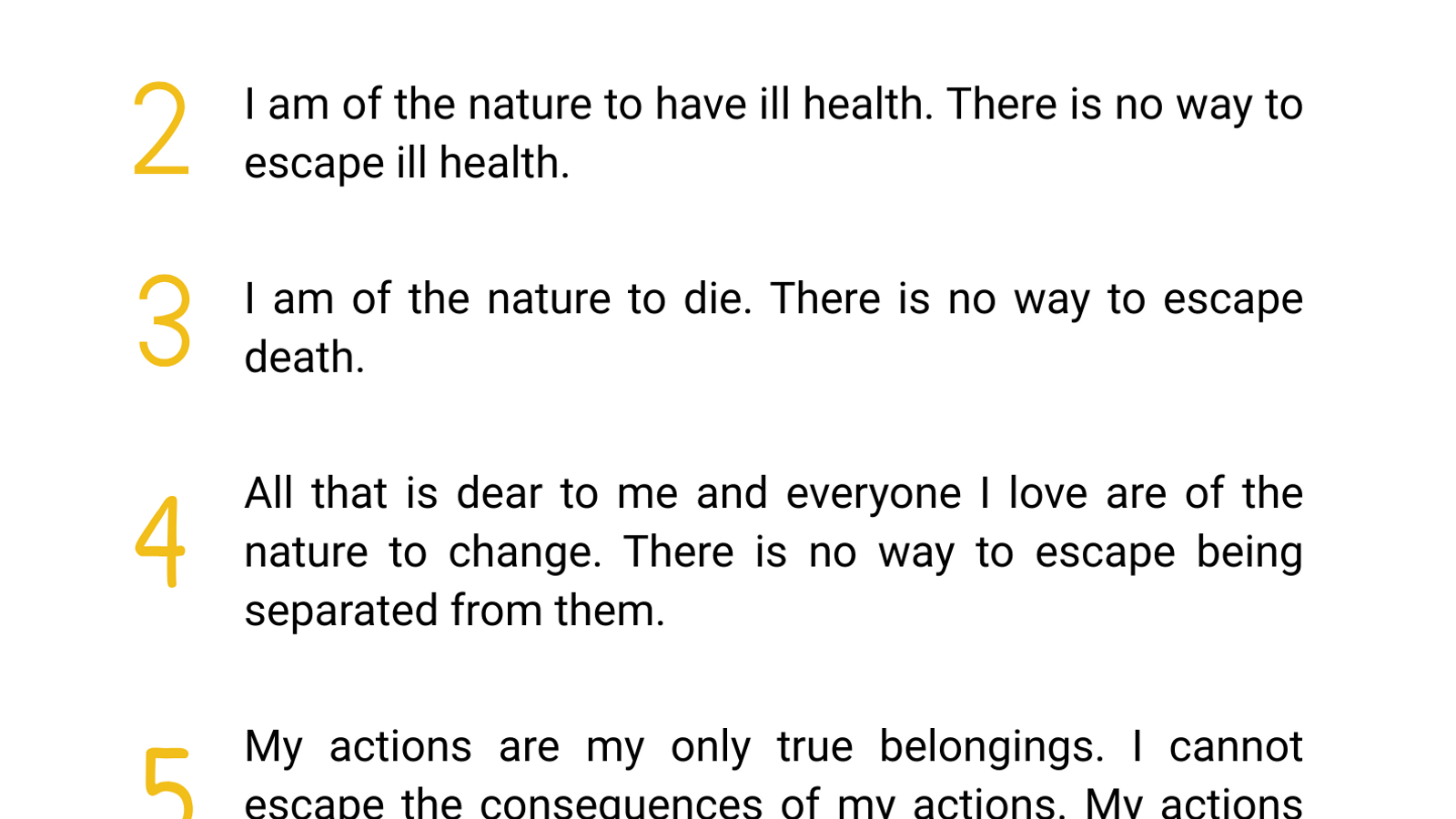
The reflection is known as The Five Remembrances, an ancient Buddhist teaching found in the early Pali Canon and later brought to life in modern times by Zen master Thich Nhat Hanh and the Plum Village community. These simple yet profound lines remind us of the realities we cannot escape: ageing, illness, death, change, and the consequences of our actions.
Reading them brought me a new sense of perspective. A reminder that when we stop resisting life's impermanence, we can begin to live with more purpose. We can live in the now. We can live for what we love.
Why the Five Remembrances matter
So much of our energy goes into avoiding thoughts of ageing, illness, or death. Yet when we allow ourselves to face these truths, something paradoxical happens. Life becomes richer, more immediate, and more precious.
These five simple statements invite us to:
Accept that ageing and illness are part of being human.
Acknowledge that death is inevitable, and that this makes every day meaningful.
Appreciate our loved ones more deeply, knowing that change and separation are part of life.
Take responsibility for our choices, remembering that our actions are what truly belong to us.
Facing what we cannot avoid does not diminish life. It softens the grip of fear and lets the ordinary become vivid again.
An invitation to reflect
As I sat with the Five Remembrances, I noticed myself pausing to ask some simple but powerful questions. I would love to invite you to take a quiet moment to reflect too.
What matters most to you right now?
How do you want to spend your time with the people you love?
What choices today feel aligned with the life you wish to create?
Sometimes just sitting with these questions, without rushing for answers, can open space for clarity and intention.
Living with purpose and intention
The Five Remembrances are not meant to be heavy or pessimistic. Instead, they remind us that life is both fragile and precious. When we truly take this in, something shifts. We begin to live with a greater sense of intention.
Living with purpose and intention does not always mean making big changes. Often it is the small, everyday choices that bring us closer to a meaningful life: making time for a loved one, slowing down enough to notice beauty in the ordinary, or choosing kindness in a moment of stress.
The Five Remembrances invite us to return, again and again, to what matters most. They are a gentle call to live not on autopilot, but with awareness, grounded in the present, guided by our values, and open to change.
I write as a way of putting language around what I see in the work. What you do with it is yours. The people I sit with often carry more resources than they realise. Often, the work is simply noticing what is already there. If something here has helped you notice, then it has served its purpose.
Natalia Cajide, Registered Psychologist
Would you like to meet Natalia →