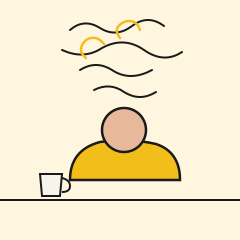
The recovery picture most people are carrying
The picture goes something like this. You are anxious now. At some point, with the right help, the anxiety will fade. You will wake up one day, perhaps after weeks or months of therapy, and notice that the thing you've been carrying around isn't there anymore. You will return to the life you had before, or to a version of yourself that hasn't had to think about anxiety in a long time. The work is to get back there.
What's incomplete about this picture isn't its outcome. Some people do experience a real reduction in their anxiety. What is incomplete is the shape. Recovery rarely arrives as a clean disappearance. It tends to be less of a return, and more of a change in your relationship with what was already there.
That's a difficult thing to put into words, partly because the language of recovery itself comes from a medical model where you either have the illness or you don't. The reality of anxious experience does not divide so cleanly. Most people have some anxiety. Some have a lot. Therapy, when it's working, does not usually move a person from a lot to none. It tends to move a person to a place where the anxiety is no longer running things.
What the research describes
What the research describes is consistent with this. Recent large-scale reviews of therapies for anxiety disorders find that meaningful change is sustained for many people across long-term follow-ups, while also acknowledging that recurrence and partial response are part of the picture for others (Cuijpers et al., 2024). What tends to change for most people is not the absence of anxiety, but the way they relate to it when it shows up.
The acceptance and commitment therapy literature has been particularly explicit about this. A 2024 review of the field describes the central work as not the reduction of anxious symptoms but the increase of psychological flexibility: the capacity to notice anxiety, hold it without being run by it, and continue to act on what matters to you (Twohig, Capel, & Levin, 2024). This is a different goal from feeling less anxious. It's also, in the long run, a more available one.
The metacognitive research arrives at something similar from a different angle. People who become less afraid of their own anxiety, less convinced that the anxiety is dangerous or uncontrollable, tend to experience the anxiety less often and less intensely over time, even when they aren't actively trying to (Nordahl et al., 2023). The relief is real, but the route to it is indirect. The relief follows the changed relationship. Not the other way around.
What I find interesting in all of this is that the picture of recovery as return, anxiety gone and life resumed, points the person in the wrong direction. It sets the work up to fail. The work, if it goes well, doesn't bring you back. It brings you somewhere different, and somewhat unfamiliar, where the anxiety is still part of the architecture, but it is no longer the load-bearing piece.
What this looks like in a life
So what does it actually look like, in practice? It looks like different things at different times, but a few patterns come up consistently enough to be worth describing.
It looks like noticing that the anxious thought arrived this morning, and being able to register it without immediately needing to either solve it or escape it. It looks like the anxiety being there during a meeting and you doing the meeting anyway, not because you forced yourself, but because the anxiety has stopped being the part of you that decides. It looks like having a stretch of weeks where the anxiety is quiet, then a week where it isn't, and not concluding from the loud week that you have lost what you had gained. It looks like being more interested in what your anxiety is responding to than in whether the anxiety is there at all.
It also looks like an ordinary life, in many cases. People who have been through this don't necessarily talk about it as transformation. They talk about it as having more room, or having more of themselves available, or being less worn out. The internal shift can be hard to see from the outside. The change is real, but it is often quieter than the picture led you to expect.
Recovery is also not linear. Most people who get there go through periods where their anxiety rises again, sometimes to levels they thought they had left behind. This is not a failure of recovery. It is part of how recovery actually moves. A return of anxiety in response to a hard period of life is not the same as falling all the way back. The recovery you've done lives in the way you respond to the anxiety, and that part doesn't unlearn itself in the way that symptoms can return.
None of this is a tidy ending. The shape of recovery from anxiety is not something I can hand you fully formed, because it doesn't arrive fully formed for anyone. What I can offer is the suggestion that the picture you may be carrying, the one in which recovery looks like a return to who you were before, is worth holding more loosely. You are not failing if the shape doesn't fit that picture. You may simply be doing the more accurate version of the work, which leaves you somewhere new.
For how we work with anxiety, what sessions cost, and how to begin, see Working with anxiety in adults.