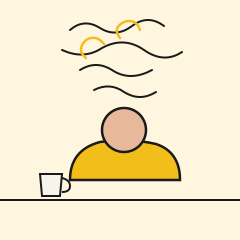
The simplest answer is that anxiety doesn't usually get bigger at night. The conditions that quiet anxiety during the day, like work demands, social contact, physical activity, and the steady stream of small distractions that make up an ordinary waking life, get smaller in the evening. The same anxiety, with fewer things to absorb it, becomes more audible. Lying in bed, with the lights off, with nothing else to do, the worry that was there all along now has the room to itself. This is the basic picture. There are a few specific mechanisms that fill it in.
Why night gives anxiety more room
During the day, your attention is on something most of the time. Tasks, conversations, traffic, screens, decisions about what to eat or what to do next. Anxiety is still present in the background, but it has competition. The mind has somewhere to put itself.
At night, the competition falls away. The room is quieter. The day is over. The mind is no longer being pulled outward, so the things it has been carrying come back into view. Researchers describe the state that develops as pre-sleep cognitive arousal, which is the mental activation that builds in the period before sleep, made up of worry, rumination, planning, and the general state of the mind not being able to settle (Shaif et al., 2025). Sleep disturbance is, for this reason, one of the features included in the diagnostic criteria for generalised anxiety and several other anxiety disorders (American Psychiatric Association, 2022).
For many people, pre-sleep cognitive arousal is mild and brief. The mind runs through the day, the day finishes processing, sleep arrives. For people who are running higher overall anxiety, or who have been carrying something specific they haven't had time to think through, pre-sleep cognitive arousal becomes louder. It is not that the night has produced anxiety. It is that the conditions that have been absorbing the anxiety all day are no longer present.
The loop that can develop
There is a second mechanism that can make this worse over time. If lying in bed has, on enough occasions, been the moment when the worry surfaced, the bed itself starts to be associated with that surfacing. The body learns this. Lying down, in the dark, becomes a cue for the mind to go into the state it has gone into many times in this exact context.
A parallel loop can develop around sleep itself. The person notices they're struggling to sleep. They worry about not sleeping. The worry about not sleeping produces more arousal, which makes sleep harder. By the time the lights go off, two anxieties are running in parallel: the original anxiety the person was carrying, and a second anxiety about whether they will be able to sleep. Research on pre-sleep arousal separates these into cognitive activation (the mind's contribution) and somatic activation (the body's contribution), and finds that both contribute to disrupted sleep, with cognitive activation often being the more powerful component (Shaif et al., 2025).
This is the pattern that, when it has been going on for some time, starts to look like insomnia. It usually starts as anxiety with nowhere to go after dark.
What this means in practice
Knowing the mechanism does not, by itself, change the experience. It does change a couple of things about how the experience gets interpreted.
The first is that the worry getting louder at night is not a sign that something is suddenly wrong. The worry was running all day. The night has simply removed the things that were holding its volume down. Treating the night as a malfunction tends to add a layer of self-criticism that wasn't earned.
The second is that the worry about not sleeping is not the same as the original anxiety. It is a separate, secondary loop with its own logic. Separating the two, in your own head, can be useful. The original worry deserves to be addressed in its own terms. The worry about sleep, paradoxically, often eases when the person stops trying so hard to make sleep happen. Persistent sleep difficulty is part of how anxiety is clinically assessed (National Institute for Health and Care Excellence, 2024), and addressing it usually involves looking at the underlying anxiety and the sleep pattern together.
What is happening at night isn't your anxiety becoming a different thing. It is your anxiety with fewer competitors. This is a frame to think with, not a verdict to apply. Hold it lightly. If it helps you describe what is going on, to yourself or to someone else, it has done its job. If the pattern has been running for long enough that sleep itself has become difficult, that's a piece worth raising with your GP, who can think about it alongside the broader picture.
For how we work with anxiety, what sessions cost, and how to begin, see Working with anxiety in adults.