


SearchFor GPs and referrersRoom Rentals
Book a Session
Worksheet · Depression

Knowing your own early signs

Recovery from low mood is often not a straight line. This is a place to map the small shifts that, for you, tend to come before a low patch.

Fillable PDF · 2 pages · 259 KB · Free, no sign-up
Written and reviewed by
The Equal Psychology team Matthew Hallam (AHPRA PSY0002471369) · Natalia Cajide (AHPRA PSY0002474316)
Last reviewed
Next review

Who it is for

For anyone who has been through a low patch and wants to recognise the lead-up next time. Dips and lifts can be part of the path, and a dip on its own does not have to mean it is all coming back. Early signs are often personal: things like replying less, a shift in sleep, or one thing quietly dropping.

The map gives you, and the people supporting you, a shared picture of your own early signs, so the noticing is not yours alone. It is something to glance at now and then, not a reason to feel on alert.

For use alongside therapy, not as a substitute, and not a safety plan. This map is for noticing early and responding gently with support, not for managing a low patch on your own. If things feel unsafe or are escalating quickly, contact your GP, your clinician, or a crisis service rather than working from this sheet.

What is inside

Page 1, read first. Why early signs are worth knowing, what they tend to be like, and three stages a low patch can move through:

Early & small
Easy to miss
Building
Starting to take hold
Later & louder
The full dip

Page 2. One area per row, with starting points for sleep and energy, pulling away, the things that drop first, how you talk to yourself, and appetite and body, plus a row that is yours alone. For each: where to look, what my early sign looks like, what it might be telling me, and a small step or who you would tell.
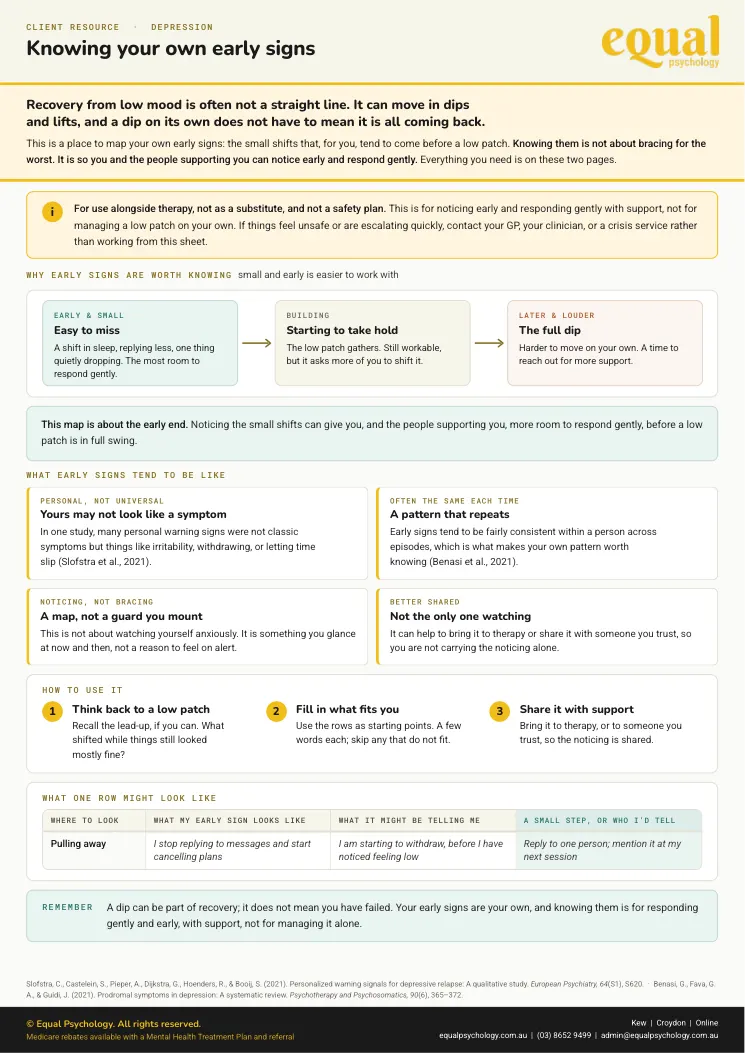
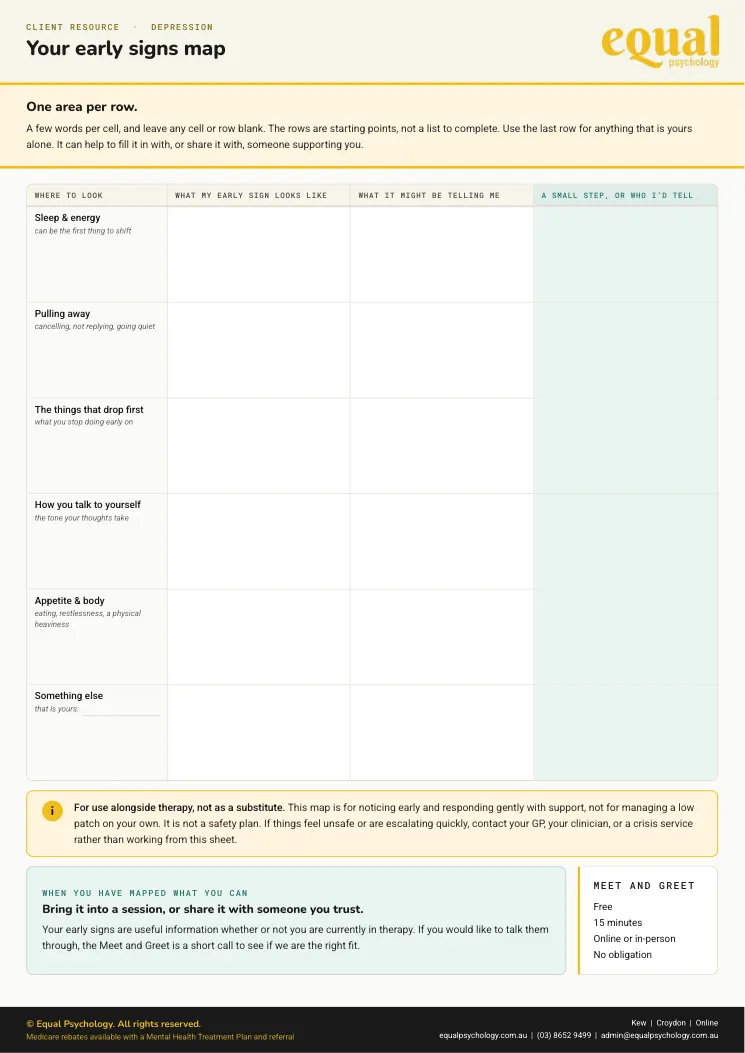
Page 1 of the worksheet Knowing your own early signs
Page 1 · Read first
Page 2 of the worksheet Knowing your own early signs, the part you fill in
Page 2 · To fill in

How to use it

  1. 1Think back to a low patchRecall the lead-up, if you can. What shifted while things still looked mostly fine?
  2. 2Fill in what fits youUse the rows as starting points. A few words each, and skip any that do not fit.
  3. 3Share it with supportBring it to therapy, or to someone you trust, so the noticing is shared.

The rows are starting points, not a list to complete, and any cell or row can stay blank. It can help to fill it in with, or share it with, someone supporting you. You can type into the PDF on a computer, or print it and write by hand.
Fillable PDF · 2 pages · 259 KB
Knowing your own early signs
Download PDF
Therapy at Equal Psychology · DepressionWorking with depression and mood in adultsWhat depression and low mood can look like, how we work with it, what sessions cost, and how to begin. See how we work with depression →
References

Slofstra, C., Castelein, S., Pieper, A., Dijkstra, G., Hoenders, R., & Booij, S. (2021). Personalized warning signals for depressive relapse: A qualitative study. European Psychiatry, 64(S1), S620.

Benasi, G., Fava, G. A., & Guidi, J. (2021). Prodromal symptoms in depression: A systematic review. Psychotherapy and Psychosomatics, 90(6), 365–372.

General information only. This worksheet is general psychoeducation, not a clinical assessment, diagnosis, or treatment. Reading it does not establish a treating relationship. If you would like personalised support, please book a Meet and Greet or speak with your GP. If you are in immediate danger, call 000, or call Lifeline on 13 11 14.