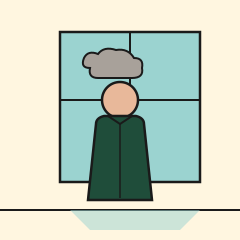
Everyone feels sad. Sadness is a normal emotional response to loss, disappointment, or stress, and it rises and falls with what is happening in your life. Depression is something more specific. It is a clinical condition in which low mood, or a loss of interest and pleasure, persists for most of the day, on more days than not, for at least two weeks, and begins to interfere with how you sleep, think, function, and relate to the people around you. The difference is one of duration, depth, breadth, and how far the state tracks your circumstances rather than running on regardless of them.
What feeling sad is
Sadness is part of the ordinary range of human feeling. It is what arises when something hurts: a loss, a setback, a disappointment, a hard week. It can be sharp or it can be heavy, and it can last for hours or for days. Like other emotions, it carries information, usually about something that matters to you, and it tends to move as your situation moves.
Feeling sad is not a sign that something has gone wrong with you. It is a sign that you are responding to your life. Most people feel sad many times, come through it without treatment, and would not describe themselves as unwell. Sadness can sit alongside a generally good mood and a working life. It takes up part of the day rather than taking the day over.
What depression is, more specifically
Depression is a clinical term for a particular pattern, defined in the diagnostic manuals used across Australian mental health practice (American Psychiatric Association, 2022). It is not simply more sadness. For the pattern to count as a depressive episode, several features need to hold together over the same stretch of time.
Low mood, or a loss of interest and pleasure in things that normally matter, has to be present for most of the day, on more days than not, for at least two weeks. Alongside it sit changes that reach into the body and mind: disturbed sleep, altered appetite, low energy, difficulty concentrating, a sense of worthlessness, and a slowing or a restlessness that other people sometimes notice. And the pattern has to be interfering with daily life rather than passing through it.
Depression in this sense is common. Around one in six Australians experience an affective, or mood, disorder such as a depressive episode at some point in their life (Australian Bureau of Statistics, 2023). It is also something a clinician diagnoses, not a website and not a self-assessment. A GP, psychologist, or psychiatrist can talk the pattern through over time, and weigh the other things that might be contributing.
The practical distinction
The most useful line between the two is not how bad the feeling is on a given day, but how the state behaves over time. Sadness tracks events. It rises when something hurts and eases as the situation changes or as time passes, and it can still be interrupted by good things: a friend, a meal, a piece of news. Depression tends to run on its own track. It stays raised for long stretches, often without a clear trigger, and it is less moved by the things that would ordinarily lift a mood.
This is why the loss of interest and pleasure matters so much as a marker. In sadness, the capacity to enjoy things is still there, even if it is muted for a while. In depression, that capacity itself can dim, so that the activities which used to land simply do not. When the dominant experience is less sadness than a flatness, or an inability to feel much at all, that is its own question, taken up separately.
Where the work goes either way
If what you recognise is sadness, the work is usually the work of life: noticing what the sadness is about, attending to what it points to, and giving it room to move. That is not a lesser thing, and it does not need a diagnosis. If what you recognise is closer to the pattern described here, low mood or lost interest that has stayed for weeks, spread across your days, and begun to interfere, then it is worth raising with a GP. Naming it accurately is not about filing yourself under a label. It is about knowing which kind of thing you are dealing with, because an ordinary sadness and a depressive episode ask for different responses. Where it is useful, the help available has good evidence behind it (National Institute for Health and Care Excellence, 2022).
For how we work with depression, what sessions cost, and how to begin, see Working with depression and mood in adults.