For anyone whose week has lost its shape after a major role ended: paid work, redundancy, long caregiving, or a role once shared with a partner. A period of disorientation after a change like this is part of ordinary adjustment. It is often your mind registering what the role used to provide, not a sign that anything is wrong with you.
The map makes the four functions visible, so the gaps and the supports show up where they actually are. You and your clinician can then see what the role carried and where each function sits now.
For use alongside therapy, not as a substitute. This map is a thinking tool, not a diagnostic instrument. A low mood that lasts most of the day for two weeks or more, and is not lifting as you make changes, warrants a conversation with a GP.
What is inside
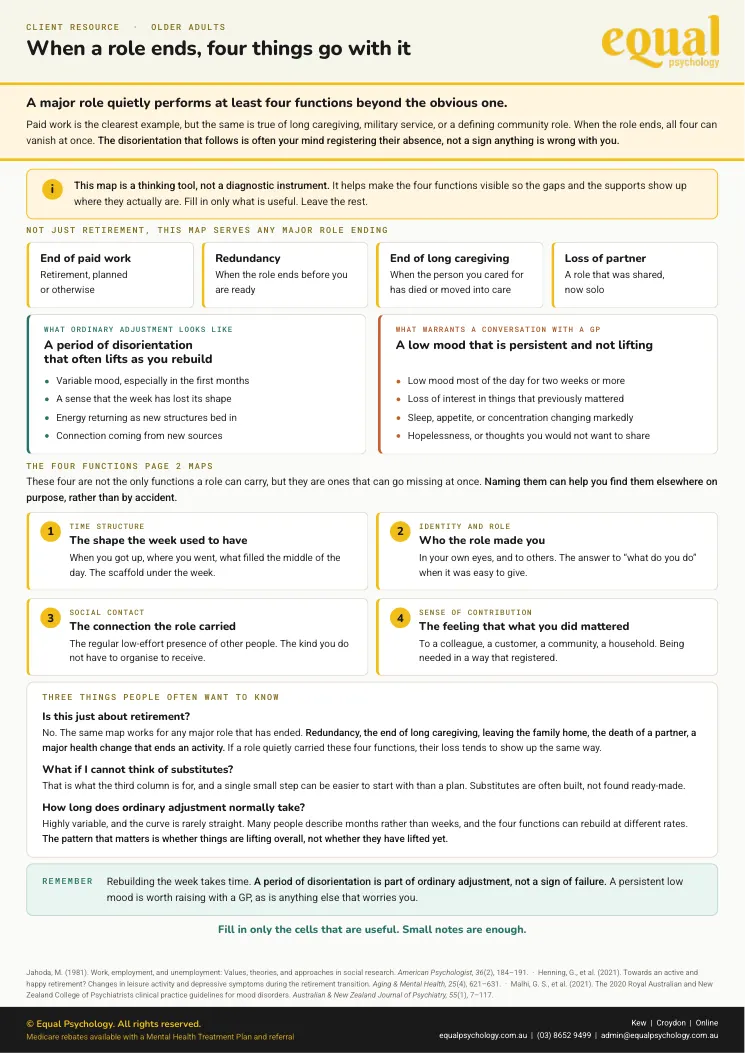
Page 1, read first.Which role endings the map applies to, how ordinary adjustment differs from a low mood worth raising with a GP, and the four functions page 2 maps:
Time structure
The shape the week used to have
Identity and role
Who the role made you
Social contact
The connection the role carried
Sense of contribution
The feeling that what you did mattered
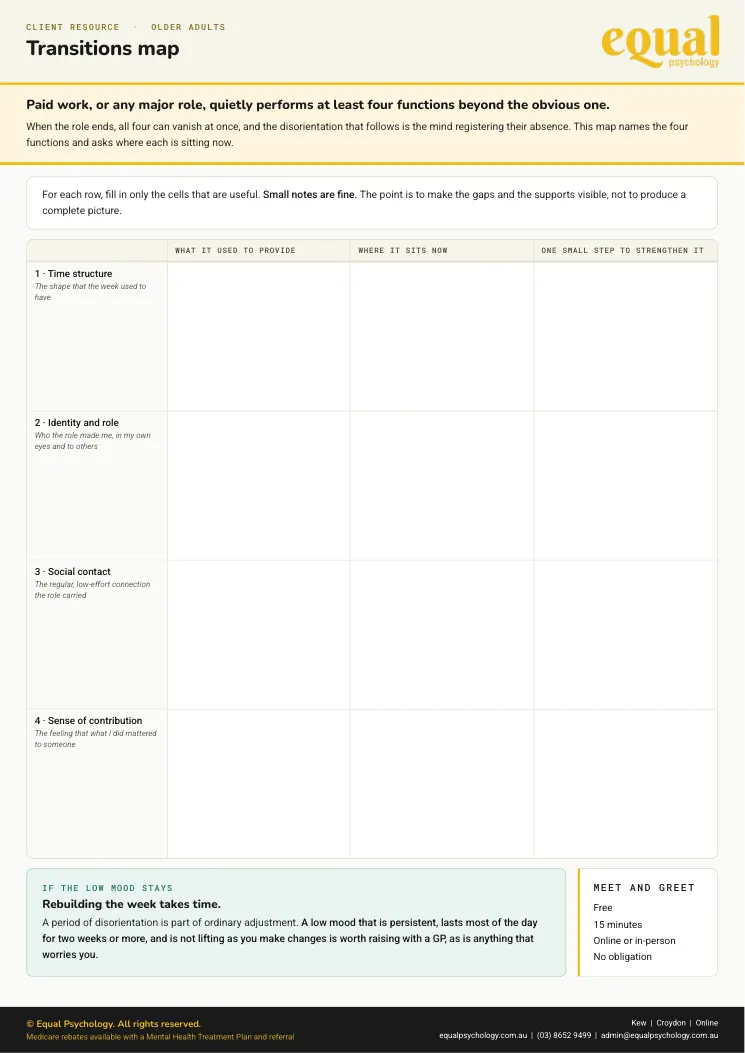
Page 2.Four rows, one for each function, with three columns: what it used to provide, where it sits now, and one small step to strengthen it.
Page 1 · Read firstPage 2 · To fill in
How to use it
1Fill only what is usefulFor each row, fill in only the cells that help. Small notes are fine. The point is to see the gaps and the supports, not to produce a complete picture.
2Look for where it sits nowFor each function, note what the role used to provide and where, if anywhere, that comes from now.
3Name one small stepUse the third column for a single small step. Substitutes are often built, not found ready-made, and a single small step can be easier to start with than a plan.
Each function can come back at its own pace, and the curve is rarely straight. Fill in only the cells that are useful. You can type into the PDF on a computer, or print it and write by hand.
One email a month from Equal Psychology with our newest posts, guides and worksheets.
References
Jahoda, M. (1981). Work, employment, and unemployment: Values, theories, and approaches in social research. American Psychologist, 36(2), 184-191.
Henning, G., et al. (2021). Towards an active and happy retirement? Changes in leisure activity and depressive symptoms during the retirement transition. Aging & Mental Health, 25(4), 621-631.
Malhi, G. S., et al. (2021). The 2020 Royal Australian and New Zealand College of Psychiatrists clinical practice guidelines for mood disorders. Australian & New Zealand Journal of Psychiatry, 55(1), 7-117.
General information only. This worksheet is general psychoeducation, not a clinical assessment, diagnosis, or treatment. Reading it does not establish a treating relationship. If you would like personalised support, please book a Meet and Greet or speak with your GP. If you are in immediate danger, call 000, or call Lifeline on 13 11 14.