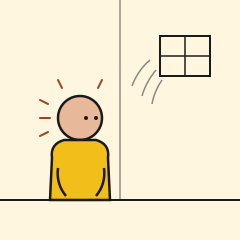
Two ways memory gets stored
The clinical and neuroscience literature distinguishes between two broad systems through which experience is stored. Explicit memory is the system most people mean when they say "memory": the conscious, narrative, autobiographical record of what happened, when, and to whom. Implicit memory is different. It is the system that stores patterns of sensation, body posture, reflexive responses, emotional states, and the felt sense associated with experience. Implicit memory is not consciously retrievable as narrative. It is recognised, instead, by what it activates.
In ordinary conditions, these two systems work together. An experience gets encoded in both, in roughly integrated form. The narrative knows what happened, and the body knows how it felt.
What changes during trauma
The narrative exposure therapy literature, particularly the work of Schauer, Neuner and Elbert in 2011, describes how trauma can disrupt the integration. When the system is overwhelmed during the experience, the autobiographical narrative may not get encoded coherently. The implicit, sensation-based record does. The result is that the body holds an organised pattern of response to what happened, while the mind may hold gaps, fragments, or no clear narrative at all.
This pattern is not the system failing. It is the system doing what it could under the conditions. The body's response was the part that mattered most for survival in the moment. The narrative was a luxury the conditions did not allow.
What this means in daily life
The clinical signs are often subtle. A particular smell, posture, room temperature, tone of voice, or time of day produces a response that does not match the current situation. The heart rate goes up, the body tenses, a familiar sense of dread arrives, and the person cannot explain why. This is implicit memory doing its work. The body has recognised something the conscious mind has not.
What makes this confusing, especially for people who have lived with these patterns for a long time, is that the response feels like it is coming from nowhere. It is not coming from nowhere. It is coming from a stored pattern that has not been integrated with conscious narrative memory.
What this changes for therapy
The implication is that trauma therapy cannot proceed by narrative alone. If the implicit-memory layer is not addressed, the body continues to respond to triggers regardless of how much conscious sense the person has made of what happened. This is one of the reasons that body-aware approaches to trauma have a place alongside cognitive and narrative approaches. The recent component network meta-analysis on complex trauma interventions by Coventry and colleagues in 2020 supported multicomponent approaches over single-modality work for exactly this reason.
It is also one of the reasons that the body's signals matter. The signals are the only honest record the implicit system has, and they are how the system communicates what it carries.
If the body remembers what the mind does not, the system has not made a mistake. It has held what it could, in the way it could. The signals it sends are information, not malfunction, and learning to listen to them is part of what gets rebuilt slowly in trauma work.
For how we work with trauma, what sessions cost, and how to begin, see Working with trauma in adults.