The intuition versus what happens
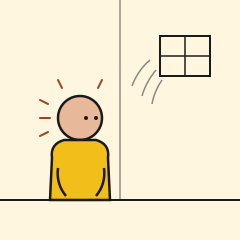
One of the things that surprises people, when they come to therapy hoping to tell the story and get it over with, is how often telling makes things worse for a while. The body activates, sleep gets worse, the days after the session feel rough. The intuition that telling should help is so widely shared that the experience of being retraumatised by telling can feel like a personal failure.
It is not. What the nervous system is doing, when it activates, shuts down, or refuses to stay present with the story, is the system doing exactly what it learned to do, which is to protect you from being overwhelmed.
The framework that explains it
The most useful clinical frame here is what Daniel Siegel calls the window of tolerance. The model describes an optimal zone of autonomic arousal within which a person can be present, reflective, and engaged. Above the window is hyperarousal: increased heart rate, racing thoughts, fight-or-flight activation. Below the window is hypoarousal: numbness, dissociation, shutdown. Inside the window, processing is possible. Outside the window, in either direction, the system is in protection mode (Siegel, 1999).
What trauma often does is narrow the window. Things that would not have activated the system before now do. Things that would have been processable now produce shutdown.
Why telling outside the window can re-injure
When a person tells a traumatic story while the body is outside the window of tolerance, three things tend to happen at once. The autonomic arousal goes up. The parts of the brain that integrate experience into coherent autobiographical memory drop in capacity. And the body learns, again, that telling produces this state, which makes future telling harder.
This is what is meant by being retraumatised by disclosure. It is not metaphorical. It is the system doing what it should do when the conditions for processing have not been met.
Why stabilisation comes first
The phased approach to trauma treatment, recommended in Australian and international guidelines, exists for this reason. A combined study of research findings published in 2020 supported a multicomponent approach with stabilisation work alongside processing (Coventry et al., 2020). A 2026 study of research findings directly comparing phased to non-phased approaches for Complex PTSD found that phased approaches produced better outcomes and lower drop-out rates than approaches that moved straight to processing (Tran et al., 2026). The order is not a clinical preference. It is the response to the mechanism.
If you have had the experience of trying to tell your story and feeling worse afterward, the experience is not evidence that you are unfit for therapy or that the story is too much. It is evidence that the conditions for processing were not yet in place. The body did what it was designed to do. The slow rebuilding of conditions the system can settle into is harder than the intuition allows, and it is part of what trauma therapy actually involves.
For how we work with trauma, what sessions cost, and how to begin, see Working with trauma in adults.